
CHEMISTRY GLOSSARY
carotenoids → karotenoidi
Carotenoids are a group of natural pigments in plants responsible for yellow and orange colours, meltable in fats.
chalcogens → halkogeni elementi
Chalcogens are the Group 16 elements: oxygen (O), sulphur (S), selenium Se), tellurium (Te), and polonium (Po). Compounds of these elements are called chalcogenides.
artificial radioactive isotope → umjetni radioaktivni izotop
Artificial radioactive isotopes are formed when an atom is bombed with an accelerator or exposing it to slow moving neutrons in a nuclear reactor. In this way isotopes (radionuclides) are obtained which are non-existent in nature because of their unstability and radioactive transition into stable isotopes. Most important radioactive isotopes are:
Radioactive isotope of cobalt is formed when ordinary metal cobalt is bombed with neutrons in a nuclear reactor.
Radioactive isotope of phosphorus is formed when ordinary phosphorus is bombed with deuterons produced in cyclotron.
radioactive isotope of carbon is formed when a nitrogen is bombed with slow moving neutrons in a nuclear reactor. It is mostly used as a radioactive indicator.
benzene → benzen
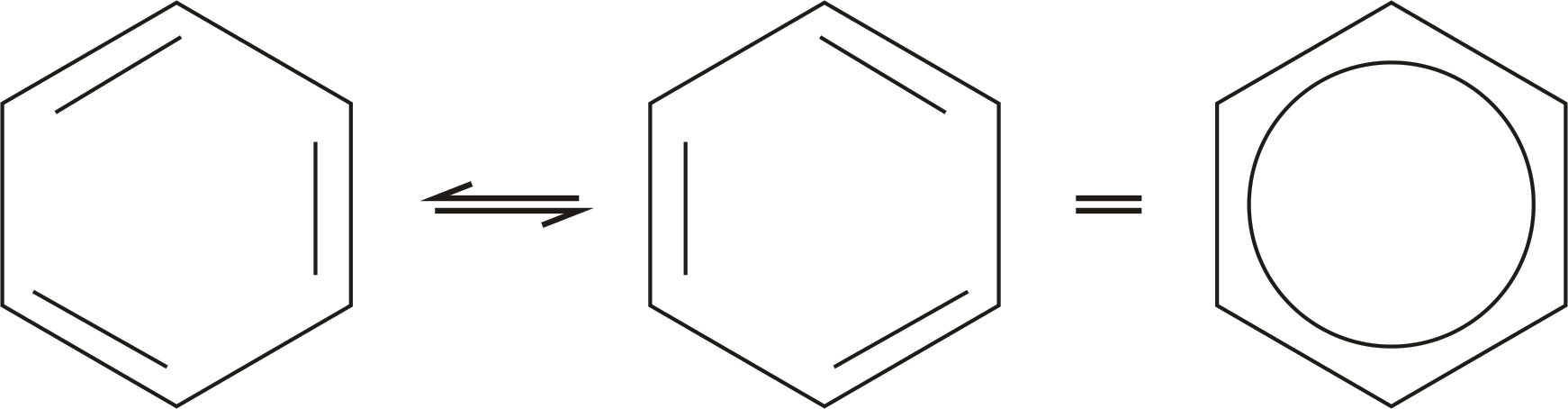
Benzene is a colourless liquid hydrocarbon, C6H6, b.p. 80 °C. It is now made from petroleum by catalytic reforming (formerly obtained from coal tar). Benzene is the archetypal aromatic compound. It has an unsaturated molecule, yet will not readily undergo addition reactions. On the other hand, it does undergo substitution reactions in which hydrogen atoms are replaced by other atoms or groups.
In 1865, Friedrich August Kekulé purposed the benzene molecule structure as a hexagonal ring which consists of six carbon atoms with alternate carbon-carbon single and carbon-carbon double bond. But such a structure should be highly reactive, and so didn't account for the unreactive nature of benzene. We now know that the best representation for the structure of benzene is indeed, hexagonal, with each C-C bond distance being identical and intermediate between those for a single and double bond. The π-orbitals from each neighbouring carbon atom overlap to form a delocalised molecular orbital which extends around the ring, giving added stability and with it, decreased reactivity. That is the reason the structural formula of benzene represents as a hexagon with a circle in the center which represents the delocalized electrons.
beta particle → beta-čestica
Beta particle is a charged particle emitted from a radioactive atomic nucleus either natural or manufactured. The energies of beta particles range from 0 MeV to 4 MeV. They carry a single charge; if this is negative, the particle is identical with an electron; if positive, it is a positron.
An unstable atomic nucleus changes into a nucleus of the same mass number but different proton number with the emission of an electron and an antineutrino (or a positron and a neutrino)
beta-glucan → beta-glukan
Beta-glucans are are naturally occurring polysaccharides that contain only glucose as structural components, and are linked with β-glycosidic bonds. They is the most known powerful immune stimulant. The most active forms of β-glucans are those comprising D-glucose units with β(1→3) links and with short side-chains of D-glucose attached at the β(1→6) position. These are referred to as beta-1,3/1,6 glucan. They are a major component of soluble dietary fiber, which can be found in cereal grains (oats, barley, wheat), yeast, and certain mushrooms (shiitake, maitake).
Biot-Savart law → Biot-Savartov zakon
The magnetic field B due to a current-carrying conductor can be determined by Biot-Savart law. The contribution to magnetic field set up at distance r by the current element IdL is given by expression:
where μ0 is permeability constant. It plays a role in magnetic problems equivalent to the role of permittivity constant μ0 in electrostatics problems. In order to obtain B, contributions of all current elements have to be integrated. In case of a long straight conductor, carrying current I, Biot-Savart law gives:
SI unit for magnetic field B is tesla (T).
Permaeability constant μ0 has value 4π×10-7 T m A-1.
chemical equation equalization → izjednačavanje kemijske jednadžbe
Chemical equation equalization is determining values of stechiometric coefficients of reactants and products in a chemical equation in a way that the number of atoms of each element is equal before and after the reaction.
chemical symbols → kemijski simboli
Chemical symbols are a derived way of showing elements in a formula or equation. Each symbol represents one atom and it usually consists of the first two letters of the Greek or Latin name of the element.
Citing this page:
Generalic, Eni. "Distribution of elements in nature." Croatian-English Chemistry Dictionary & Glossary. 29 June 2022. KTF-Split. {Date of access}. <https://glossary.periodni.com>.


 English