
CHEMISTRY GLOSSARY
metalloid → polumetal
Metalloid (semimetal) is any of a class of chemical elements intermediate in properties between metals and nonmetals. The classification is not clear cut, but typical metalloids are boron (B), silicon (Si), germanium (Ge), arsenic (As), and tellurium (Te). They are electrical semiconductors and their oxides are amphoteric.
Earth’s crust → Zemljina kora
Crust is outer layer of the solid earth, above the Mohorovicic discontinuity. Its thickness averages about 35 km on the continents and about 7 km below the ocean floor, and has the approximate chemical composition:
| Element | Percentage (%) |
|---|---|
| oxygen | 47 |
| silicon | 28 |
| aluminium | 8 |
| iron | 4.5 |
| calcium | 3.5 |
| sodium | 2.5 |
| potassium | 2.5 |
| magnesium | 2.2 |
electrochemical series → elektrokemijski niz
Electrochemical series is a series of chemical elements arranged in order of their standard electrode potentials. The hydrogen electrode
is taken as having zero electrode potential. An electrode potential is, by definition, a reduction potential.
Elements that have a greater tendency than hydrogen to lose electrons to their solution are taken as electropositive; those that gain electrons from their solution are below hydrogen in the series and are called electronegative.
The series shows the order in which metals replace one another from their salts; electropositive metals will replace hydrogen from acids.
electronegativity → elektronegativnost
Electronegativity is a parameter originally introduced by L. Pauling which describes, on a relative basis, the power of an atom to attract electrons. For example, in hydrogen chloride, the chlorine atom is more electronegative than the hydrogen and the molecule is polar, with a negative charge on the chlorine atom.
There are various ways of assigning values for the electronegativity of an element. Pauling electronegativities are based on bond dissociation energies using a scale in which fluorine, the most electronegative element, has the value 4 and francium, the lowest electronegative element, has the value 0.7.
micelle → micele
Micelle is an electrically charged colloidal particle, usually organic in nature, composed of aggregates of large molecules, e.g., in soaps and surfactants. For aqueous solutions, the hydrophilic end of the molecule is on the surface of the micelle, while the hydrophobic end (often a hydrocarbon chain) points toward the centre.
molecular formula → molekularna formula
Molecular formula is a formula which represents one molecule of an element or a compound, and the number of atoms in each one of them.
nascent state → nascentno stanje
Nascent state is an especially active state of an element in a moment when it is released from a compound during chemical reaction, e.g. nascent hydrogen.
neon → neon
Neon was discovered by Sir William Ramsay and Morris W. Travers (England) in 1898. The origin of the name comes from the Greek word neon meaning new. It is colourless, odourless inert gas. Non-reactive even with fluorine. Fourth most abundant element in the universe. Neon is obtained by liquefaction of air and separated from the other gases by fractional distillation. Primarily for lighting.
Faraday’s laws of electrolysis → Faradayevi zakoni elektrolize
Faraday’s laws of electrolysis are two laws found by British chemist and physicist Michael Faraday (1791-1867) in his experiments on electrolysis:
1. The quantity of matter extracted on the electrode is proportional to the quantity of charge (Q = I·t) which has flown in electrolysis time.
where z = number of electrons changed in reaction and F = Faraday’s constant which equals 96 487 C mol-1.
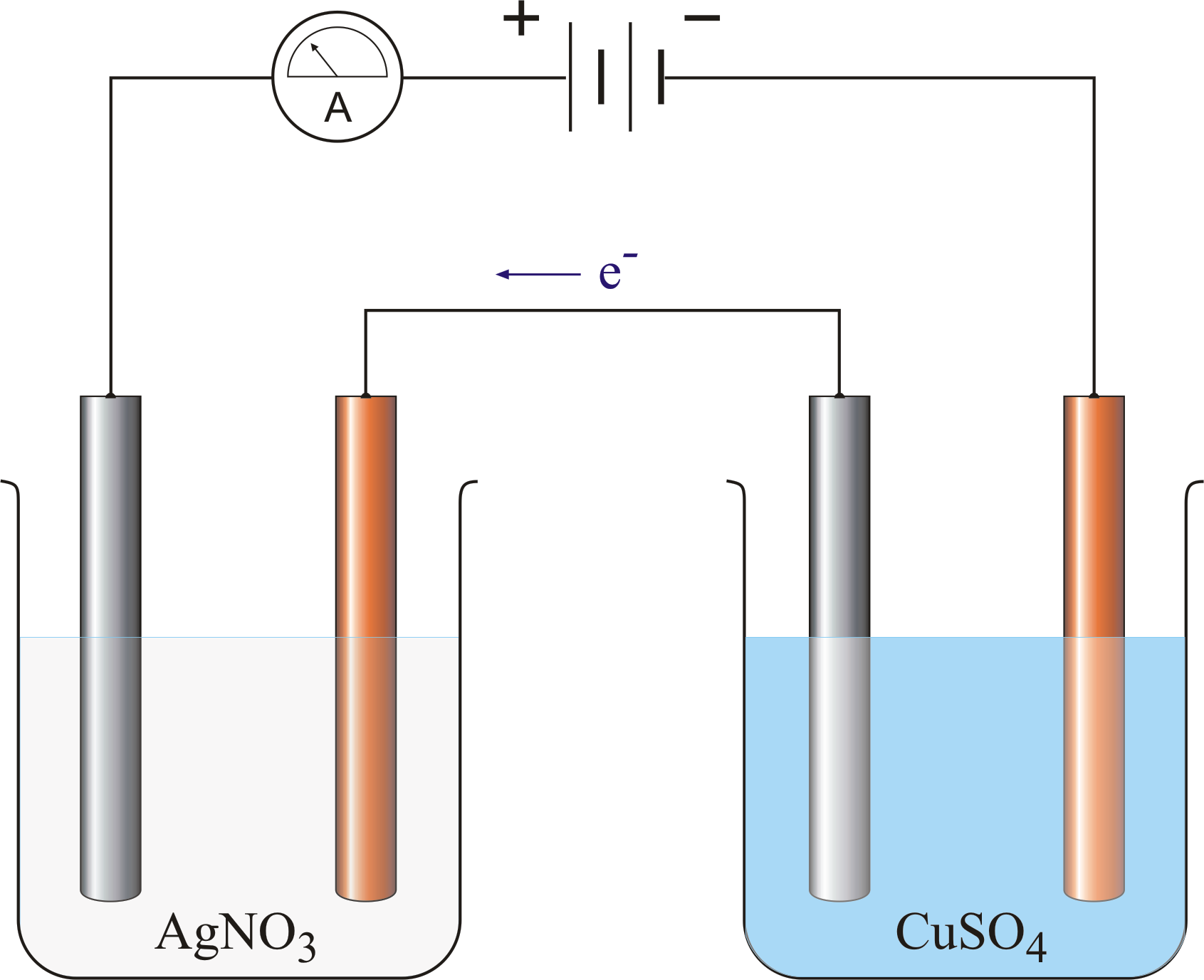
2. The masses of the elements liberated by the same quantity of electricity are directly proportional to their chemical equivalents.
96 487 C will discharge 1 mol Ag and 1/2 mol Cu. The relevant half reactions are:
Citing this page:
Generalic, Eni. "Distribution of elements in nature." Croatian-English Chemistry Dictionary & Glossary. 29 June 2022. KTF-Split. {Date of access}. <https://glossary.periodni.com>.


 English
