
CHEMISTRY GLOSSARY
peptisation → peptizacija
Peptisation is a process in which coagulated colloid returns into a dispersed state.
precipitate → precipitat
Precipitate or the deposit is an insoluble solid formed by reactions in a solution. For example, when a solution of silver nitrate is added to a solution of sodium chloride, insoluble silver chloride precipitates.
Tyndall’s effect → Tyndallov efekt
Tyndall’s effect occurs when light disperses on colloid particles. This phenomenon can be seen when a ray of light enters in dark room through a small hole. In the beam some dust particles of colloid dimensions can be seen sparkling.
ultracentrifuge → ultracentrifuga
Ultracentrifuge is a high-speed centrifuge used in the separation of colloidal or submicroscopic particles. The ultracentrifuge can generate forces thousands or millions of times stronger than the force of gravity.
condensation → kondenzacija
1. Condensation is a process of changing from a gaseous to a liquid or solid state, usually done by cooling.
2. Condensation, in colloid systems, is a process where smaller particle join in one colloid size particle
3. Condensation, in chemical terms, is a sort of chemical reaction in which small molecules like water, carbon dioxide, or ammonia single out.
Dewar flask → Dewarova posuda
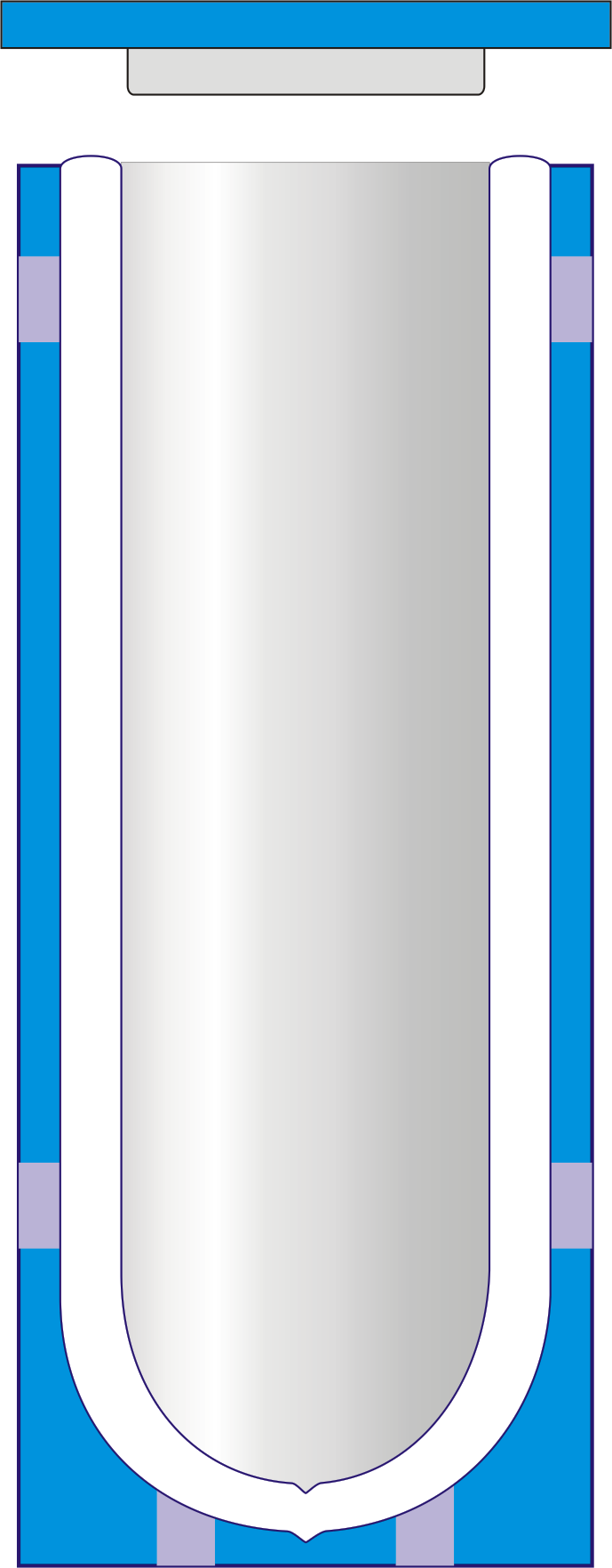
Dewar flask or vacuum bottle is a container for storing hot or cold substances. It consists of two flasks, one placed inside the other, with a vacuum between. The vacuum prevents the conduction of heat from one flask to the other. For greater efficiency the flasks are silvered to reflect heat. The substance to be kept hot or cold, e.g., liquid air, is contained in the inner flask. The flask is named after British chemist and physicist Sir James Dewar (1842-1923). Dewar invented the Dewar flask in 1892 to aid him in his work with liquid gases. The common thermos bottle is an adaptation of the Dewar flask.
dialysis → dijaliza
Dialysis is a method by which large molecules (such as starch or protein) and small molecules (such as glucose or amino acids) may be separated in a solution by selective diffusion through a semipermeable membrane. Through this kind of membrane dissolved particles pass and colloid dimension particles fall behind. For example, if a mixed solution of starch and glucose is placed in a closed container made of a semipermeable substance (such as cellophane), which is then immersed in a beaker of water, the smaller glucose molecules will pass trough the membrane into the water, while the starch molecules remain behind.
dysprosium → disprozij
Dysprosium was discovered by Paul Emile Lecoq de Boisbaudran (France) in 1886. The origin of the name comes from the Greek word dysprositos meaning hard to obtain. It is soft, lustrous, silvery metal. Reacts with oxygen. Reacts rapidly with water; dissolves in acids. Metal ignites and burns readily. Reductant. Dysprosium usually found with erbium, holmium and other rare earths in some minerals such as monazite sand. Dysprosium uses are limited to the experimental and esoteric. Some isotopes of dysprosium are effective absorbers of thermal neutrons and are being considered for use in the control rods in nuclear reactors.
zeta potential → zeta potencijal
Zeta potential (ζ) is the potential across the interface of all solids and liquids. Specifically, the potential across the diffuse layer of ions surrounding a charged colloidal particle, which is largely responsible for colloidal stability. Also called electrokinetic potential.
electrode of the first kind → elektroda prvog reda
Electrode of the first kind is a simple metal electrode immersed in a solution containing its own ion (e.g., silver immersed in a silver nitrate solution). The equilibrium potential of this electrode is a function of the concentration (more correctly of activity) of the cation of the electrode metal in the solution (see Nernst’s electrode potential equation).
Citing this page:
Generalic, Eni. "Colloid silver." Croatian-English Chemistry Dictionary & Glossary. 29 June 2022. KTF-Split. {Date of access}. <https://glossary.periodni.com>.


 English