
CHEMISTRY GLOSSARY
protactinium → protaktinij
Protactinium was discovered by Otto Hahn (Germany) and Lise Meitner (Austria) in 1917. The origin of the name comes from the Greek word protos meaning first. It is very rare, silvery-white, extremely radioactive metal. Resists alkalis; reacts with oxygen and acids. Attacked by steam. Highly radiotoxic. Protactinium is extremely toxic and must be handled with great care. Protactinium does not occur in nature. Found among fission products of uranium, thorium and plutonium.
proton → proton
Proton is a stable elementary particle of unit positive charge and spin 1/2. Protons and neutrons, which are collectively called nucleons, are the constituents of the nucleus.
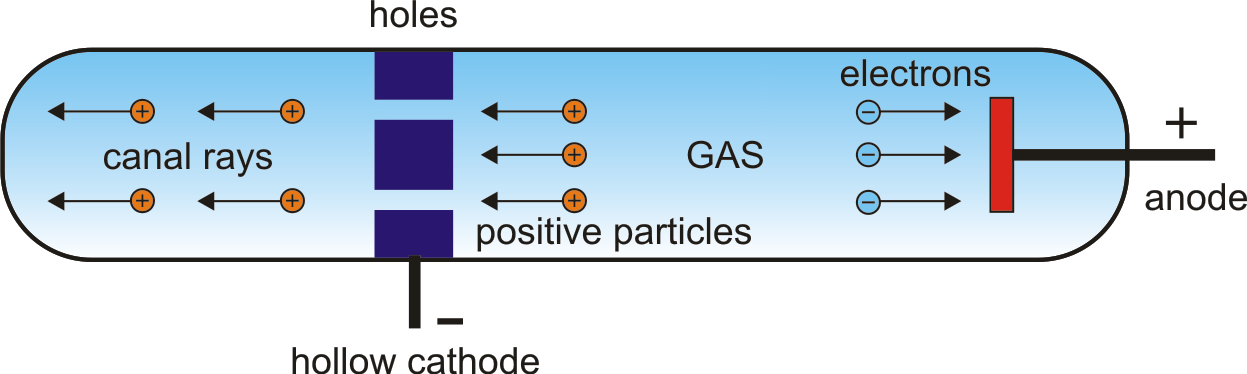
In 1886, German physicist Eugene Goldstein (1850-1930) discovered positive particles by using a modified Crookes tube with holes in the cathode in an evacuated tube. When cathode rays were given off in one direction toward the anode, other rays found their way through the holes in the cathode and sped off in the opposite direction. Since these other rays traveled in the direction opposite to the negatively charged cathode rays, it seemed that they must be composed of positively charged particles. Rutherford suggested that this fundamental positive particle be called the proton.
Zeeman, Pieter → Zeeman, Pieter
Pieter Zeeman (1865-1943) was a Dutch physicist who discovered the splitting of the spectral lines of a substance when placed in a magnetic field (known as the Zeeman effect). In 1902, Zeeman and Lorentz were jointly awarded the Nobel Prize in Physics, for their, extraordinary service they rendered by their researches into the influence of magnetism upon radiation phenomenon.
zeta potential → zeta potencijal
Zeta potential (ζ) is the potential across the interface of all solids and liquids. Specifically, the potential across the diffuse layer of ions surrounding a charged colloidal particle, which is largely responsible for colloidal stability. Also called electrokinetic potential.
redox potential → redoks potencijal
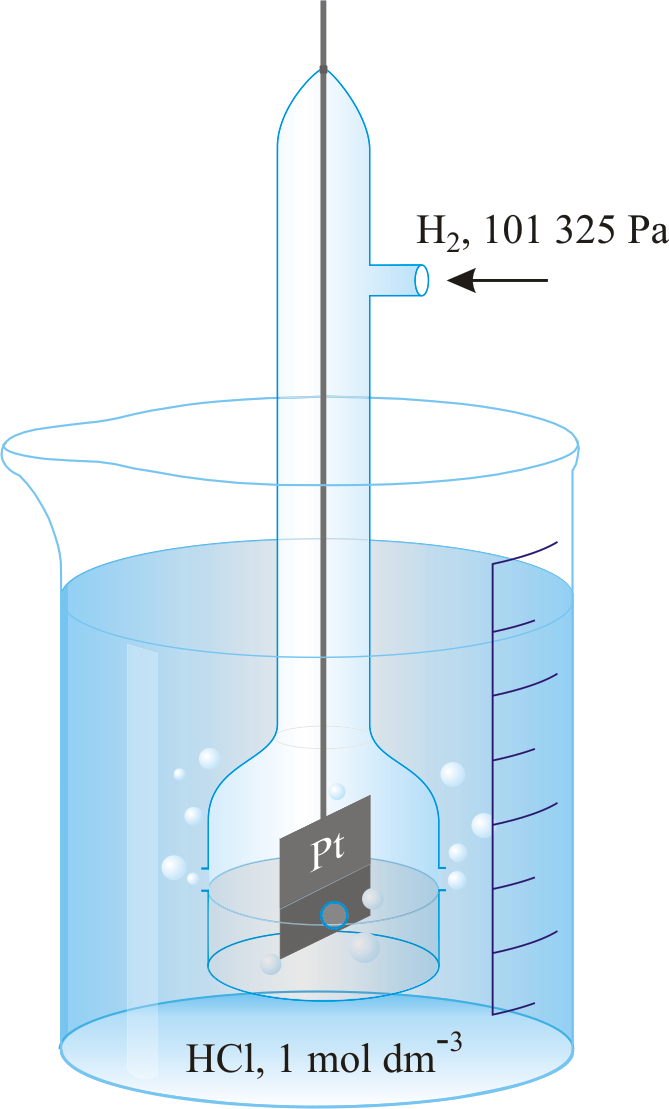
Redox potential is the potential of a reversible oxidation-reduction electrode measured with respect to a reference electrode, corrected to the hydrogen electrode, in a given electrolyte.
reversible process → reverzibilan proces
Reversible process or reaction is those that can be reversed by an infinitesimally small change in conditions. For example, ice and water coexist at 101 325 Pa and 0 °C; a very slight temperature increase causes the ice to melt; a tiny temperature decrease causes the water to freeze. Melting or freezing under these conditions can be considered reversible.
sacrificial protection → zaštita žrtvovanom elektrodom
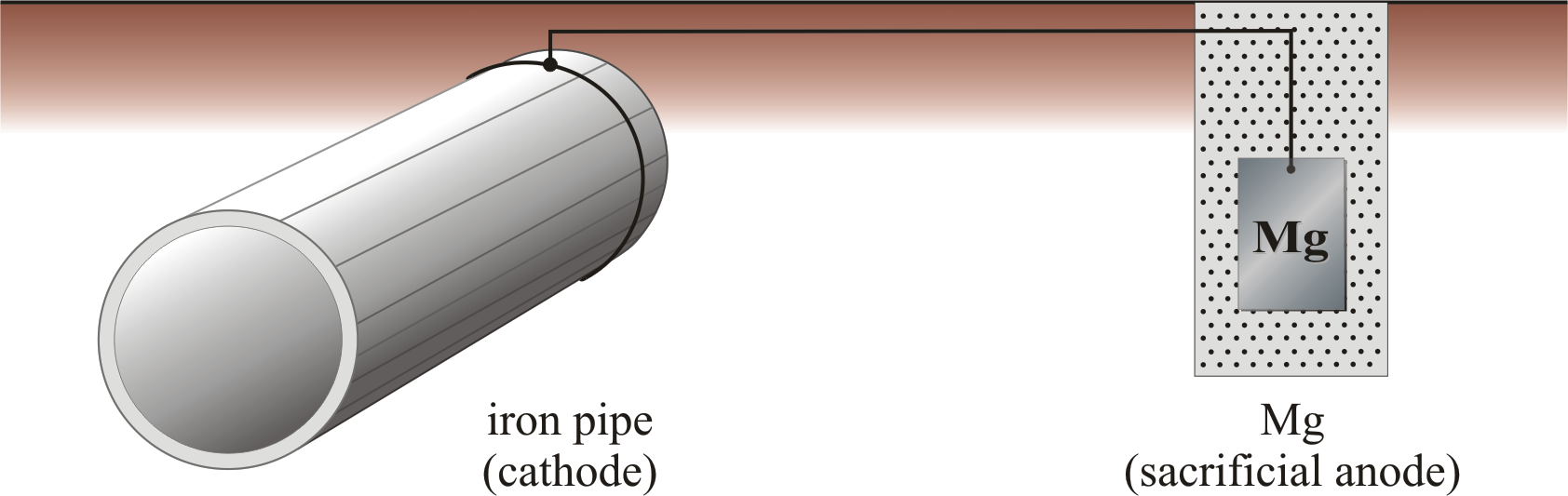
Sacrificial protection is the protection of iron or steel against corrosion by using a more reactive metal. Pieces of zinc or magnesium alloy are attached to pump bodies and pipes. The protected metal becomes the cathode and does not corrode. The anode corrodes, thereby providing the desired sacrificial protection. These items are known as sacrificial anodes and "attract" the corrosion to them rather than the iron/steel. The sacrificial anodes must be replaced periodically as they corrode.
The iron pipe will be connected to a more reactive metal such as magnesium through cooper wires, the magnesium will donate its electrons to the iron preventing it from rusting. Iron which is oxidises will immediately be reduced back to iron.
solubility product constant → konstanta produkta topljivosti
Solubility product constant (Ksp) (or the solubility product) is the product of the molar concentrations of the constituent ions, each raised to the power of its stoichiometric coefficient in the equilibrium equation. For instance, if a compound AaBb is in equilibrium with its solution
the solubility product is given by
Solvay’s process → Solvayev postupak
Solvay ’s process is an industrial process for producing sodium carbonate from sodium chloride and ammonia and carbon dioxide.
Carbon dioixide is produced by the thermal decomposition of limestone, CaCO3(s).
Quicklime, formed as a by-product of the thermal decomposition of limestone, is treated with water to form calcium hydroxide.
Calcium hydroxide is heated with ammonium chloride to form ammonia and calcium chloride (by product).
Carbon dioxide reacts with ammonia to form ammonium carbonate.
Ammonium carbonate further reacts with carbon dioxide to form ammonium bicarbonate.
Ammonium bicarbonate then react with sodium chloride to form sodium bicarbonate.
Dry sodium bicarbonate is heated in rotary furnace to give anhydrous sodium carbonate or soda ash.
The carbon dioxide produced is recycled back into the process.
spontaneous process → spontani proces
Spontaneous process is a process that occurs without outside intervention. No external forces are required to keep the process going, although external forces may be required to get the process started. For example, the burning of wood is spontaneous once the fire is started. The combination of water and carbon dioxide to reform the wood and oxygen is NOT spontaneous! Spontaneity is independent of rate. To be spontaneous a process must increase the entropy of the universe.
Citing this page:
Generalic, Eni. "S.t.p.." Croatian-English Chemistry Dictionary & Glossary. 29 June 2022. KTF-Split. {Date of access}. <https://glossary.periodni.com>.


 English

