
CHEMISTRY GLOSSARY
toxicity → toksičnost
The term toxicity is very widely used in the safety context. It is used in two contrasting senses: to denote the capacity to cause harm to a living organism, and to indicate the adverse effects caused by a chemical.
transitional temperature → prijelazna temperatura
Transitional temperature is a temperature at which the crossing from one kind of crystals to another appears to be of the same matter (polymorphy).
solution composition → sastav otopine
Solutions are homogenous mixtures of several components. The component which is found in a greater quantity is called the solvent and the other components are called solutes. Quantitative composition of a solution can be expressed by concentration (amount, mass, volume and number), by fraction (amount, mass, and volume), ratio (amount, mass, and volume) and by molality. Amount, mass, and volume ratio are numerical, nondimensional units and are frequently expressed as percentage (% = 1/100), promile (‰ = 1/1000) or parts per million (ppm = 1/1 000 000). If it is not defined, it is always related to the mass ratio.
Soxhlet extractor → Soxhletov ekstraktor
Soxhlet extractor is a laboratory apparatus designed to extract substances with a low solubility in the extracting solvent. The method described by the German chemist Franz von Soxhlet (1848-1926) in 1879 is the most commonly used example of a semi-continuous method applied to extraction of lipids from foods. In the Soxhlet extractor, the sample soaks in hot solvent that is periodically siphoned off, distilled and returned to the sample. During each cycle, a portion of the non-volatile compound dissolves in the solvent. After many cycles the desired compound is concentrated in the distillation flask. The solvent in the flask is then evaporated and the mass of the remaining lipid is measured.

spectrophotometer → spektrofotometar
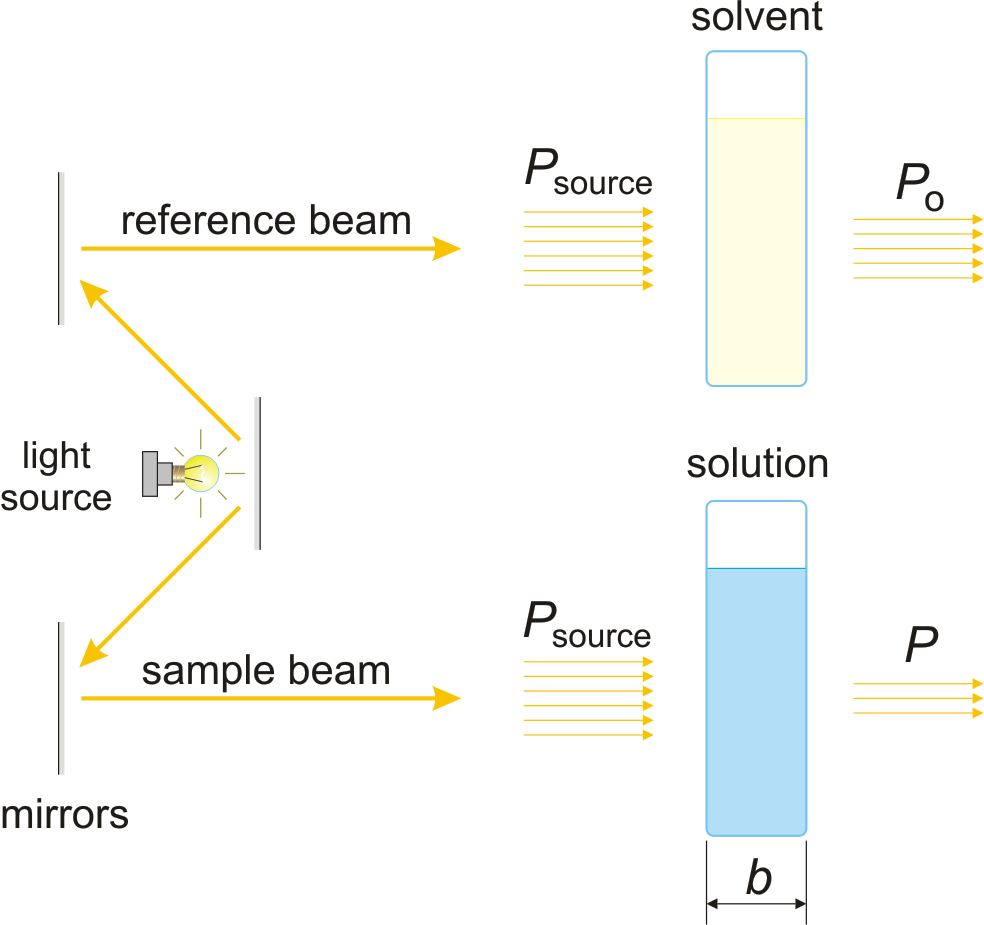
Spectrophotometer is an instrument for measuring the amount of light absorbed by a sample.
The absorption of light by a substance in a solution can be described mathematically by the Beer-Lambert law
where A is the absorbance at a given wavelength of light, ε is the molar absorbtivity or extinction coefficient (L mol-1 cm-1), unique to each molecule and varying with wavelength, b is the length of light path through the sample (cm), and c is the concentration of the compound in solution (mol L-1).
unit cell → jedinična ćelija
Unit cell is the smallest fragment of the structure of a solid that by repetition can generate the entire structure.
unluminescent flame → nesvijetleći plamen
Unliminescent flame appears when there is enough oxygen for complete matter burnout.
unsaturated solution → nezasićena otopina
Unsaturated solution is a solution that contains less than the maximum possible equilibrium concentration of a solute.
urethane → uretan
Urethane is actually a misnomer as applied to polyurethane foam. It is a colorless, crystalline substance used primarily in medicines, pesticides, and fungicides. Urethane is not used in the production of urethane polymers or foams. The urethanes of the plastics industry are so named because the repeating units of their structures resemble the chemical urethane.
Citing this page:
Generalic, Eni. "Optički aktivna tvar." Croatian-English Chemistry Dictionary & Glossary. 29 June 2022. KTF-Split. {Date of access}. <https://glossary.periodni.com>.


 English
