
CHEMISTRY GLOSSARY
law of definite composition → zakon o određenom sastavu
Law of definite composition states that the elements in a given compound are always combined in the same proportion by mass. This law form the basis for the definition of a chemical compound.
diatomaceous earth → dijatomejska zemlja
Diatomaceous earth is a naturally occurring siliceous sedimentary mineral compound from microscopic skeletal remains (frustules) of diatoms, unicellular aquatic plants of microscopic size. Their fossilized remains are called diatomite and contains approximately 3000 diatom frustules per cubic millimetre.
Diatomite is relatively inert and has a high absorptive capacity, large surface area, and low bulk density. It consists of approximately 90 % silica, and the remainder consists of compounds such as aluminum and iron oxides. The fine pores in the diatom frustules make diatomite an excellent filtering material for waters, beverages, oils, chemicals, as well as many other products.
dipole molecule → dipolna molekula
Dipole molecules are created when mutual electronic pair at covalent bond is asymmetrical. If different atoms are bonded by a covalent bond, which can have different electron affinity, then the the atom with greater electron affinity will attract the electron pairs more strongly. In this way an asymmetrical distribution of negative charge appears in a molecule, so one part of the molecule becomes relatively negatively (the one closer to the electron pair) and the other becomes relatively positively charged.
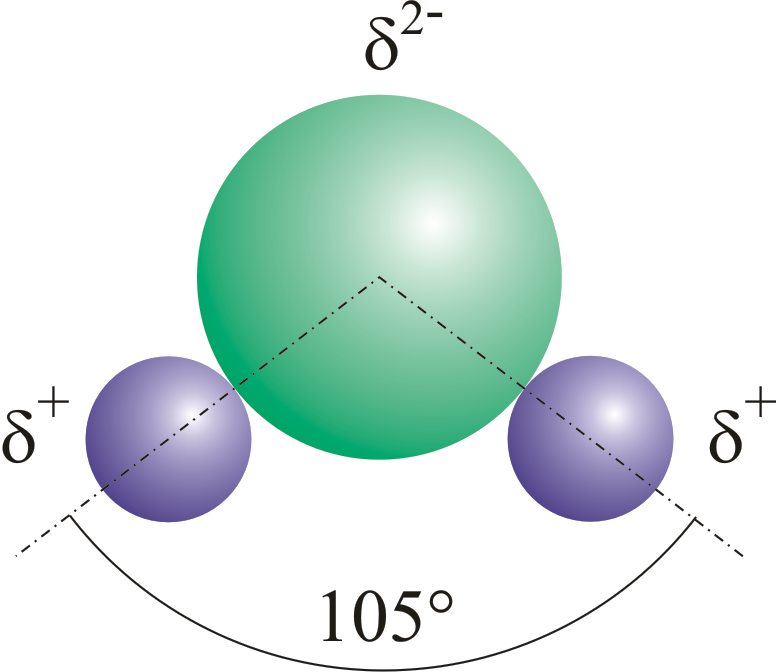
dipole moment → dipolni moment
Electric dipole moment (μ) is a product of the positive charge and the distance between the charges. Dipole moments are often stated in debyes; The SI unit is the coulomb metre. In a diatomic molecule, such as HCl, the dipole moment is a measure of the polar nature of the bond; i.e. the extent to which the average electron charges are displaced towards one atom (in the case of HCl, the electrons are attracted towards the more electronegative chlorine atom). In a polyatomic molecule, the dipole moment is the vector sum of the dipole moments of the individual bonds. In a symmetrical molecule, such as tetrafluoromethane (CF4) there is no overall dipole moment, although the individual C-F bonds are polar.
dubnium → dubnij
Dubnium was discovered by workers at the Nuclear Institute at Dubna (USSR) and by workers at the University of California, Berkeley (USA) in 1967. The origin of the name dubnium is the Joint Nuclear Institute at Dubna, Russia, an institute heavily involved in the search for heavy elements. It is synthetic radioactive metal. Dubnium was made by bombarding californium-249 with a beam of nitrogen-15 ions. There are now five known isotopes of dubnium. The longest-lived is dubnium-262, with a half-life of 34 seconds.
line spectrum → linijski spektar
Red-hot gases give line spectrum, i.e. is they emit electromagnetic rays of defined wavelengths. That kind of emission line of spectrum is characteristic of each chemical element.
mass number → maseni broj
Mass number (A) is a characteristic property of a specific isotope of an element, equal to the sum of the number of protons and neutrons in the nucleus.
Citing this page:
Generalic, Eni. "Distribution of elements in nature." Croatian-English Chemistry Dictionary & Glossary. 29 June 2022. KTF-Split. {Date of access}. <https://glossary.periodni.com>.


 English