
CHEMISTRY GLOSSARY
oxidation number → oksidacijski broj
Atoms can give one or more electrons for bond forming. The valence of any atom, which comes from stechiometrical relation of interbonded atoms, is called an oxidation number or an oxidation degree. Oxidation number of atoms in elementary state is zero. An atom of greater electronegativity has a negative, and an atom of lesser electronegativity has a positive oxidation number.
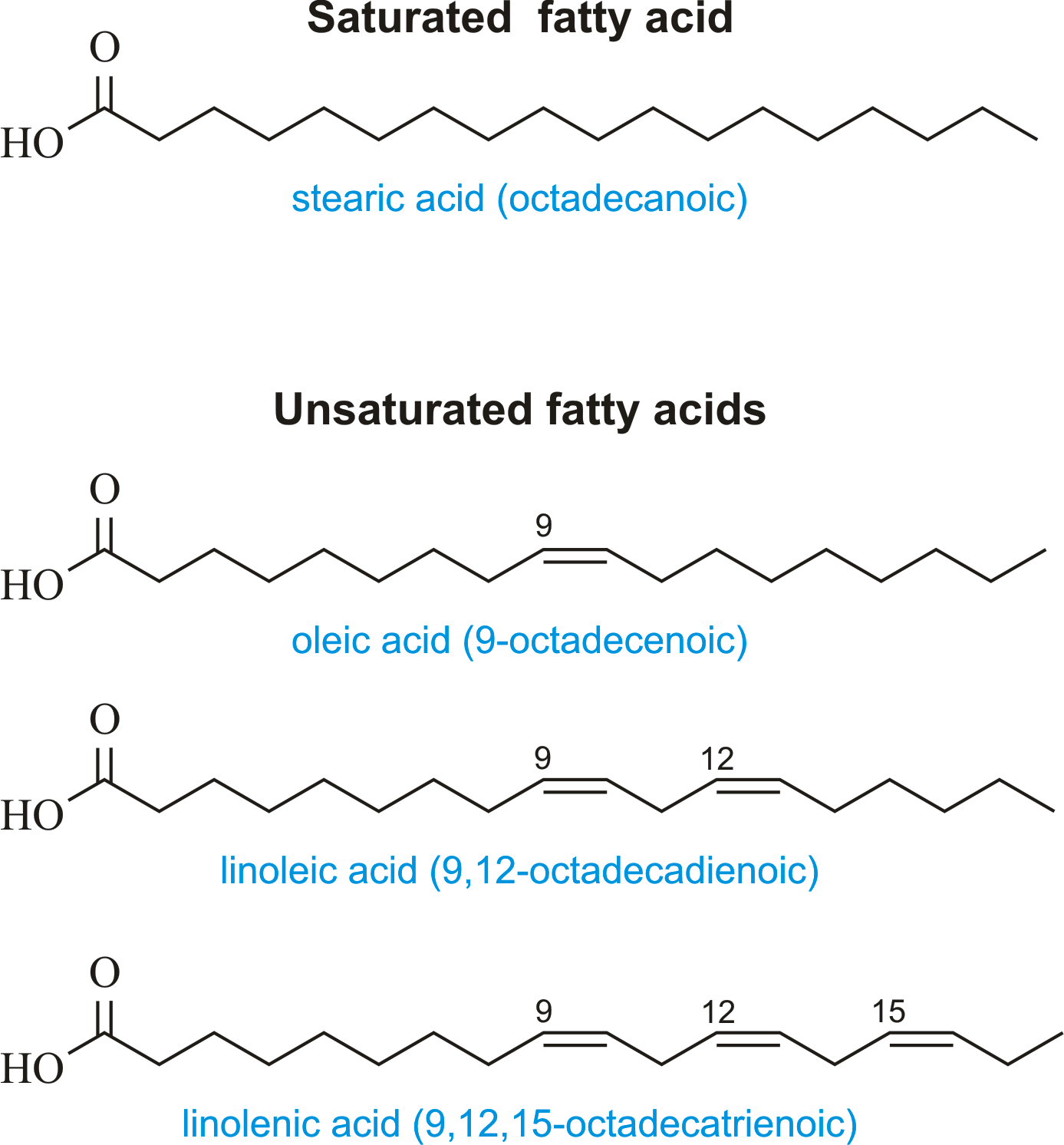
unsaturated fatty acid → nezasićena masna kiselina
Unsaturated fatty acid is a fatty acid whose carbon chain can absorb additional hydrogen atoms. Their carbon chain has one or more double or triple valence bond per molecule. The most important of these are:
| Oleic (9-octadecenoic acid) | CH3(CH2)7CH=CH(CH2)7COOH |
| Linoleic (9,12-octadecadienoic acid) | CH3(CHCH2)3(CH2CH=CH)2(CHCH2)7COOH |
| Linolenic (9,12,15-octadecatrienoic acid) | CH3(CH2CH=CH)3(CHCH2)7COOH |
absolute zero → apsolutna nula temperature
Absolute zero is theoretically, the lowest attainable temperature. It is the energy at which the kinetic energy of atom and molecules is minimal and is equivalent to -273.15 °C.
acid → kiselina
Acid is a type of compound that contains hydrogen and dissociates in water to produce positive hydrogen ions. The reaction for an acid HA is commonly written:
In fact, the hydrogen ion (the proton) is solvated, and the complete reaction is:
This definition of acids comes from the Arrhenius theory. Such acids tend to be corrosive substances with a sharp taste, which turn litmus red and produce colour changes with other indicators. They are referred to as protonic acids and are classified into strong acids, which are almost completely dissociated in water, (e.g. sulphuric acid and hydrochloric acid), and weak acids, which are only partially dissociated (e.g. acetic acid and hydrogen sulphide). The strength of an acid depends on the extent to which it dissociates, and is measured by its dissociation constant.
In the Lowry-Brønsted theory of acids and bases (1923), the definition was extended to one in which an acid is a proton donor (a Brønsted acid), and a base is a proton acceptor (a Brønsted base). An important feature of the Lowry-Brønsted concept is that when an acid gives up a proton, a conjugate base is formed that is capable of accepting a proton.
Similarly, every base produces its conjugate acid as a result of accepting a proton.
For example, acetate ion is the conjugate base of acetic acid, and ammonium ion is the conjugate acid of ammonia.
As the acid of a conjugate acid/base pair becomes weaker, its conjugate base becomes stronger and vice versa.
A further extension of the idea of acids and bases was made in the Lewis theory. In this, a G. N. Lewis acid is a compound or atom that can accept a pair of electrons and a Lewis base is one that can donate an electron pair. This definition encompasses "traditional" acid-base reactions, but it also includes reactions that do not involve ions, e.g.
in which NH3 is the base (donor) and BCl3 the acid (acceptor).
Avogadro, Amadeo → Avogadro, Amadeo
Amadeo Avogadro (1776-1856) is an Italian chemist and physicist that proposed a correct molecular explanation for Gay-Lussac’s law of combining volumes. His work provided a simple way to determine atomic weights and molecular weights of gases. He is published a theory about the movement of particles in gases that became known as Avogadro’s Law.
blackbody → crno tijelo
In radiation physics, an ideal blackbody is a theoretical object that absorbs all the radiant energy falling upon it and emits it in the form of thermal radiation. Planck’s radiation law gives the power radiated by a unit area of blackbody, and the Stefan-Boltzman law expresses the total power radiated.
addition reactions → reakcije adicije
Addition reactions are normally occur with unsaturated compounds and involve the addition of one molecule (called the reactant) across the unsaturated bond (i.e. the double bond or the triple bond) of another molecule (called the substrate) to give a single product, formed by the combination of both reacting molecules.
For example, bromine adds across the double bond of ethene in an addition reaction to form dibromoethane.
Citing this page:
Generalic, Eni. "Valence bond theory." Croatian-English Chemistry Dictionary & Glossary. 29 June 2022. KTF-Split. {Date of access}. <https://glossary.periodni.com>.


 English
