
CHEMISTRY GLOSSARY
deuterium lamp → deuterijeva svjetiljka
Deuterium or hydrogen lamp is used as a source of continuous radiation in UV part of the spectrum.
natural caoutchouc → prirodni kaučuk
Natural caoutchouc is an addition polymer of isoprene. It is obtained from tropical plant of rubber-tree by coagulation of rubber-tree-milk.
natural gas → prirodni plin
Natural gas is a naturally occurring mixture of gaseous hydrocarbons. The approximate composition of natural gas is 85 % methane, 10 % ethane, 3 % propane, with lesser amounts of butane, and other higher alkanes. Natural gas is used as a fuel and for the manufacture of chemicals.
natural resins → prirodne smole
Natural resins are organic compounds which are secreted by some plants and insects. They are used as adhesives, and are very often unsoluble in water.
laminar flow → laminarno strujanje
Laminar flow is a smooth, uniform, non-turbulent flow of a gas or liquid in parallel layers, with little mixing between layers. It is characterised by small values of the Reynolds number.

scandium → skandij
Scandium was discovered by Lars Fredrik Nilson (Sweden) in 1879. The origin of the name comes from the Latin word Scandia meaning Scandinavia. It is fairly soft, silvery-white metal. Burns easily. Tarnishes readily in air. Reaction with water releases hydrogen. Reacts with air and halogens. Scandium occurs mainly in the minerals thortveitile (~34 % scandium) and wiikite. Also in some tin and tungsten ores. Pure scandium is obtained as a by-product of uranium refining. Scandium metal is used in some aerospace applications. Scandium oxide (Sc2O2) is used in the manufacture of high-intensity electric lamps. Scandium iodide (ScI3) is used in lamps that produce light having a colour closely matching natural sunlight.
absorbance → apsorbancija
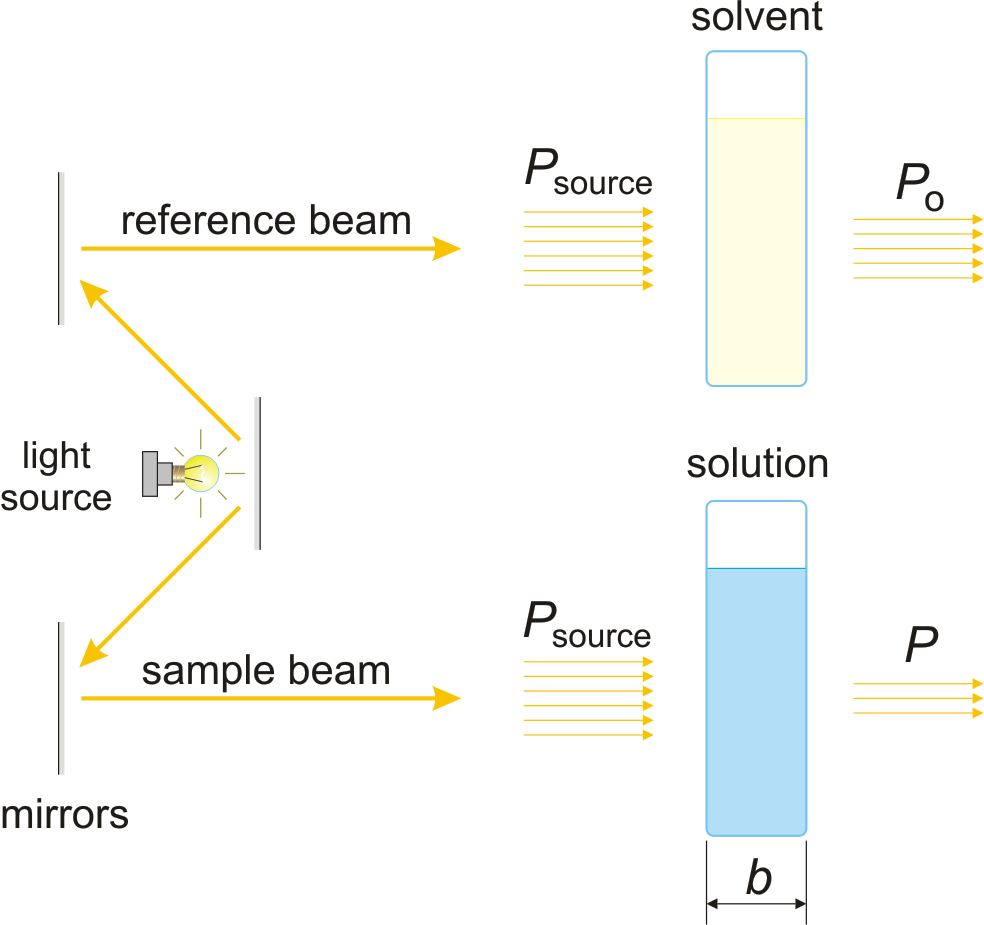
Absorbance (A) is a logarithm of the ratio of incident radiant power (Po) to transmitted radiant power (P) through a sample (excluding the effects on cell walls).
The absorption of light by a substance in a solution can be described mathematically by the Beer-Lambert law
where A is the absorbance at a given wavelength of light, ε is the molar absorbtivity or extinction coefficient (L mol-1 cm-1), unique to each molecule and varying with wavelength, b is the length of light path through the sample (cm), and c is the concentration of the compound in solution (mol L-1).
actinides → aktinoidi
Actinides (actinons or actinoids) are the fourteen elements from thorium to lawrencium inclusive, which follow actinium in the periodic table. The position of actinium is somewhat equivocal and, although not itself an actinide, it is often included with them for comparative purpose. The series includes the following elements: thorium (Th), protactinium (Pa), uranium (U), neptunium (Np), plutonium (Pu), amercium (Am), curium (Cm), berkelium (Bk), californium (Cf), einsteinium (Es), fermium (Fm), mendelevium (Md), nobelium (No) and lawrencium (Lr). Every known isotope of the actinide elements is radioactive. Traces of Pa, Np and Pu are consequently found, but only Th and U occur naturally to any useful extent.
adrenaline → adrenalin
Adrenaline was the first naturally produced hormone to be isolated in its pure state. It is known as epinephrine, but its chemical name is 1-[3,4-dihydroxyphenol]-2-methylaminoethanol. Adrenaline is a hormone, produced by the medulla of the adrenal glands, that increases heart activity, improves the power and prolongs the action of muscles, and increases the rate and depth of breathing to prepare the body for "fright, flight, or fight". At the same time it inhibits digestion and excretion.
alkanes → alkani
Alkanes (paraffins) are acyclic branched or unbranched hydrocarbons having the general formula CnH2n+2, and therefore consisting entirely of hydrogen atoms and saturated carbon atoms. In the systematic chemical nomenclature alkane names end in the suffix -ane. They form a homologous series (the alkane series) methane (CH4), ethane (C2H6), propane (C3H8), butane (C4H10), etc. The lower members of the series are gases; the high-molecular mass alkanes are waxy solid. Generaly the alkanes are fairly unreactive. They form haloalkanes with halogens when irradiated with ultraviolet radiation. Alkanes are present in natural gas and petroleum.
Citing this page:
Generalic, Eni. "Natural_Urbano_Umbra_Floor_Lamp." Croatian-English Chemistry Dictionary & Glossary. 29 June 2022. KTF-Split. {Date of access}. <https://glossary.periodni.com>.


 English
