
CHEMISTRY GLOSSARY
ampere → amper

Ampere (A) is the SI base unit of electric current.
The ampere is that constant current which, if maintained in two straight parallel conductors of infinite length, of negligible circular cross-section, and placed 1 metre apart in vacuum, would produce between these conductors a force equal to 2×10⁻⁷ newton per metre of length.
Buchner flask → Buchnerova tikvica
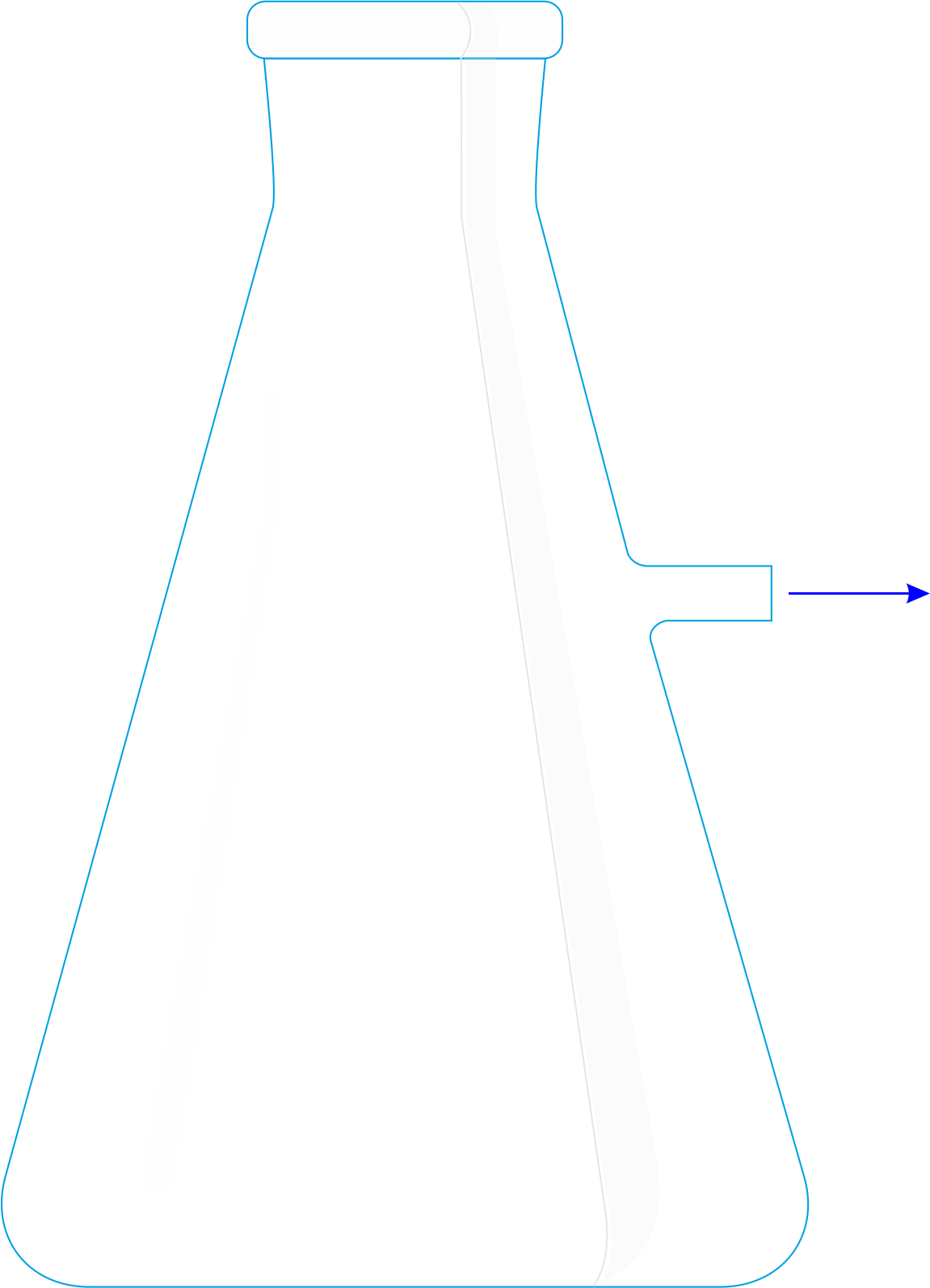
Büchner flask (also known as a vacuum flask, filter flask, side-arm flask or Kitasato flask) is a thick-walled Erlenmeyer flask with a side arm to which a vacuum can be applied.
Gaussian system of units → Gaussov sustav jedinica
Gaussian system of units is a hybrid system used in electromagnetic theory, which combines features of both the electrostatic cgs subsystem (esu) and electromagnetic cgs subsystem (emu). With three base units, it uses em units in magnetism and es units in electrostatics. This involves using the constant c (the velocity of light in vacuum) to interrelate these sets of units.
light year → svjetlosna godina
Light year (ly) is a unit of distance used in astronomy, defined as the distance light travels in one year in a vacuum (ly = 9.46052973·1015 m).
purification → pročišćavanje
Purification is the physical or chemical process of removing contaminants from a compound. The physical processes may include sublimation, distillation, filtration, crystallisation, or extraction. The chemical processes may involve formation of a derivative, purification of the derivative and recovery of the original material in a pure form of the derivative.
caesium → cezij
Caesium was discovered by Robert Bunsen and Gustav Kirchhoff (Germany) in 1860. The origin of the name comes from the Latin word caesius meaning sky blue or heavenly blue. It is very soft, light grey, ductile metal. Reacts readily with oxygen. Reacts explosively with water. Caesium is found in pollucite [(Cs4Al4Si9O26)·H2O] and as trace in lepidolite. Used as a ’getter’ to remove air traces in vacuum and cathode-ray tubes. Also used in producing photoelectric devices and atomic clocks. Since it ionises readily, it is used as an ion rocket motor propellant.
cathode → katoda
Cathode is a negative electrode of an electrolytic cell to which positively charged ions (cations) migrate when a current is passed as in electroplating baths.
In a primary or secondary cell (battery or accumulator) the cathode is the electrode that spontaneously becomes negative during discharge, and form which therefore electrons emerge.
In vacuum electronic devices electrons are emitted by the cathode and flow to the anode.
Coulomb’s law → Coulombov zakon
Coulomb’s law is the statement that the force F between two electrical charges q1 and q2 separated by a distance r is
where εo is the permittivity of a vacuum, equal to
refractive index → indeks loma
For a non-absorbing medium, refractive index (n) is the ratio of the velocity of electromagnetic radiation (light) in vacuum to the phase velocity of radiation of a specified frequency in the medium.
Citing this page:
Generalic, Eni. "Vacuum filtration,1713711111." Croatian-English Chemistry Dictionary & Glossary. 29 June 2022. KTF-Split. {Date of access}. <https://glossary.periodni.com>.


 English