
CHEMISTRY GLOSSARY
high fructose corn syrup → visoko fruktozni kukuruzni sirup
High fructose corn syrup (HFCS) is commonly used in place of sugar in foods and drinks. Corn starch is hydrolyzed to glucose, which is then treated with glucose isomerase to produce a fructose-rich mixture. HFCS is available in a number of forms, named according to the percentage of fructose they contain, HFCS-55 for instance contains 55 % fructose and 45 % glucose. The enhanced sweetness, low cost and ease of use are the main reasons why manufacturers now prefer to use high fructose corn syrup instead of sugar.
transuranium element → trasuranski element
Transuranium elements are elements with an atomic number higher than 92 (uranium’s atomic number). Transuranium elements are unstable and occur in extremely low concentrations in nature. Most are made artificially.
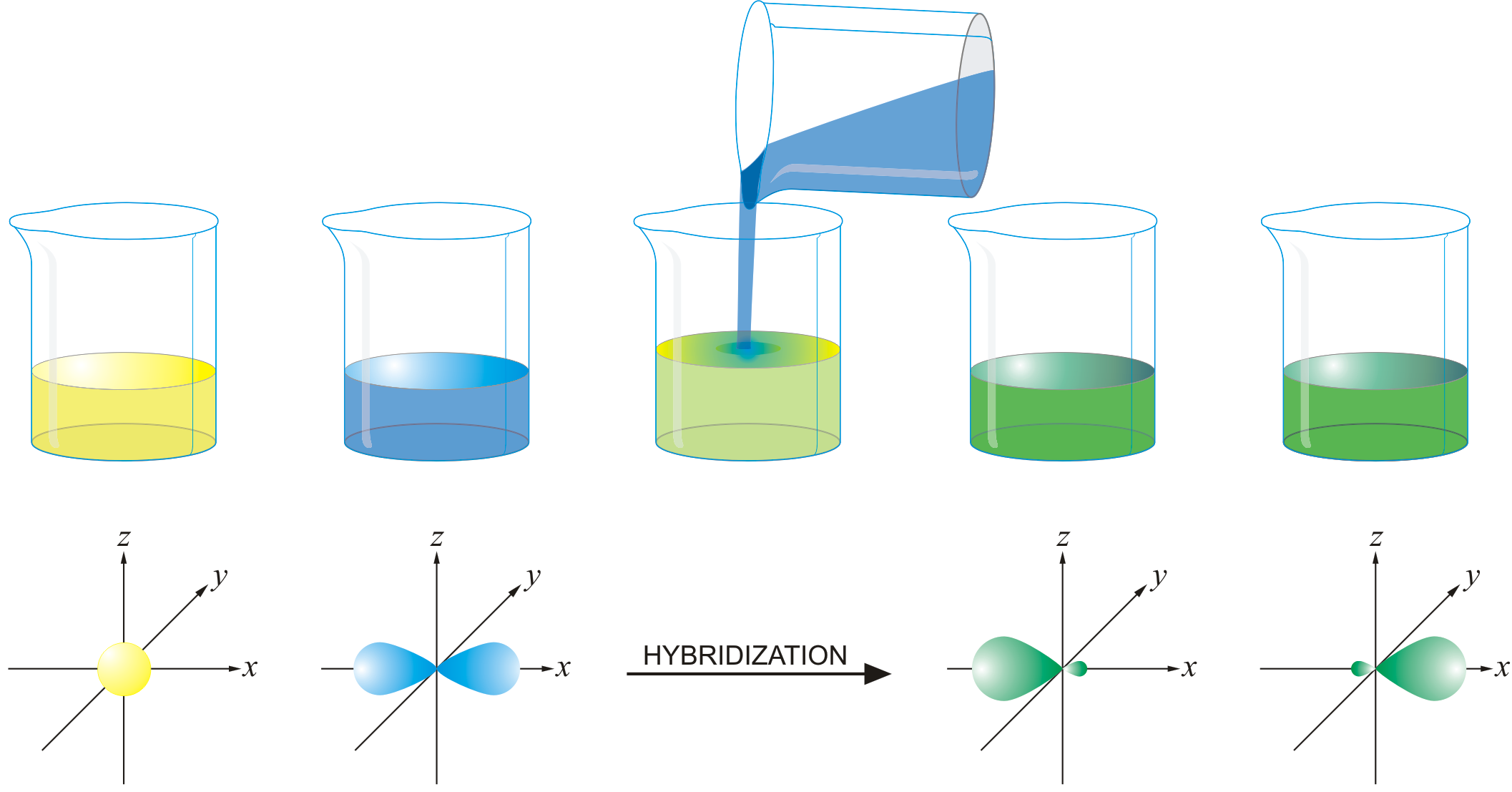
hybrid orbital → hibridne orbitale
Hybrid orbital is an orbital created by mixing together atomic orbitals to form an equal number of new hybrid atomic orbitals. For example, a common hybridization is sp3 where s orbital combine with a three p orbitals to form four new orbitals. After hybridization, all hybrid orbitals have the same energy, lower than p orbitals, but higher than s orbitals.
Ilkovic equation → Ilkovičeva jednadžba
Ilkovic equation is a relation used in polarography relating the diffusion current (id) and the concentration of the depolarizer (c), which is the substance reduced or oxidized at the dropping mercury electrode. The Ilkovic equation has the form
Where k is a constant which includes Faraday constant, π and the density of mercury, and has been evaluated at 708 for max current and 607 for average current, D is the diffusion coefficient of the depolarizer in the medium (cm2/s), n is the number of electrons exchanged in the electrode reaction, m is the mass flow rate of Hg through the capillary (mg/sec), and t is the drop lifetime in seconds, and c is depolarizer concentration in mol/cm3.
The equation is named after the scientist who derived it, the Slovak chemist, Dionýz Ilkovič 1907-1980).
ionic bond → ionska veza
Ionic bond is a strong force of attraction holding atoms together in a molecule or crystal. Typically chemical bonds have energies of about 100 kJ mol-1. Ionic bond is a bond at which one of the participants, during the procedure of bonding, gives away its unpaired electrons to another atom so that both can achieve electron arrangement of the closest noble gas. In order to form an ionic bond one of the atoms must cross to the positively charged ion by losing certain number of electrons and the other atom must receive those electrons and cross to the negatively charged ion.

valence shell → valentna ljuska
Valence shell is the shell corresponding to the highest value of principal quantum number in the atom. The valence electrons in this shell are on average farther from the nucleus than other electrons. They are often directly involved in chemical reaction.
X-ray spectrum → spektar X-zraka
X-ray spectrum is a set of characteristic X-ray frequencies or wavelengths produced by a substance used as a target in an X-ray tube. Each element has a characteristic X-ray spectrum, and there is a strong correlation between atomic number and the frequencies of certain lines in the X-ray spectrum.
laminar flow → laminarno strujanje
Laminar flow is a smooth, uniform, non-turbulent flow of a gas or liquid in parallel layers, with little mixing between layers. It is characterised by small values of the Reynolds number.

lanthanides → lantanoidi
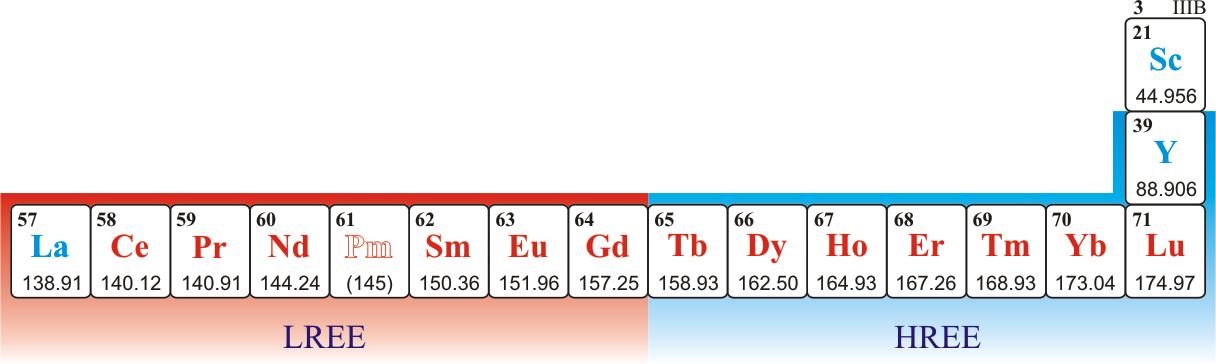
Lanthanides (lanthanons, lanthanoids or rare-earth elements) are a series of fourteen elements in the periodic table, generally considered to range in proton number from cerium to lutetium inclusive. It was convenient to divide these elements into the cerium group or light earth: cerium (Ce), praseodymium (Pr), neodymium (Nd), promethium (Pm), samarium (Sm), europium (Eu); and the yttrium group or heavy earths: gadolinium (Gd), terbium (Tb), dysprosium (Dy), holmium (Ho), erbium (Er), thulium (Tm), ytterbium (Yb) i lutetium (Lu). The position of lanthanum is somewhat equivocal and, although not itself a lanthanide, it is often included with them for comparative purpose. The lanthanides are sometimes simply called the rare earths. Apart from unstable Pm, the lanthanides are actually not rare. Cerium is the 26. most abundant of all elements, 5 times as abundant as Pb. All are silvery very reactive metals.
Citing this page:
Generalic, Eni. "Stoichiometric number." Croatian-English Chemistry Dictionary & Glossary. 29 June 2022. KTF-Split. {Date of access}. <https://glossary.periodni.com>.


 English


