
CHEMISTRY GLOSSARY
cracking cotton → praskavi pamuk
Cracking cotton is nitrocellulose with high contents of nitrogen (around 13 %). It is used for the production of smokeless gunpowder.
critical mass → kritična masa
Critical mass is the minimum mass of a fissionable material (235U or 239Pu) that will initiate an uncontrolled chain reaction as in an atomic bomb. The critical mass of pure 239Pu is about 4.5 kg, and of 235U about 15 kg.
Carnot cycle → Carnotov kružni proces
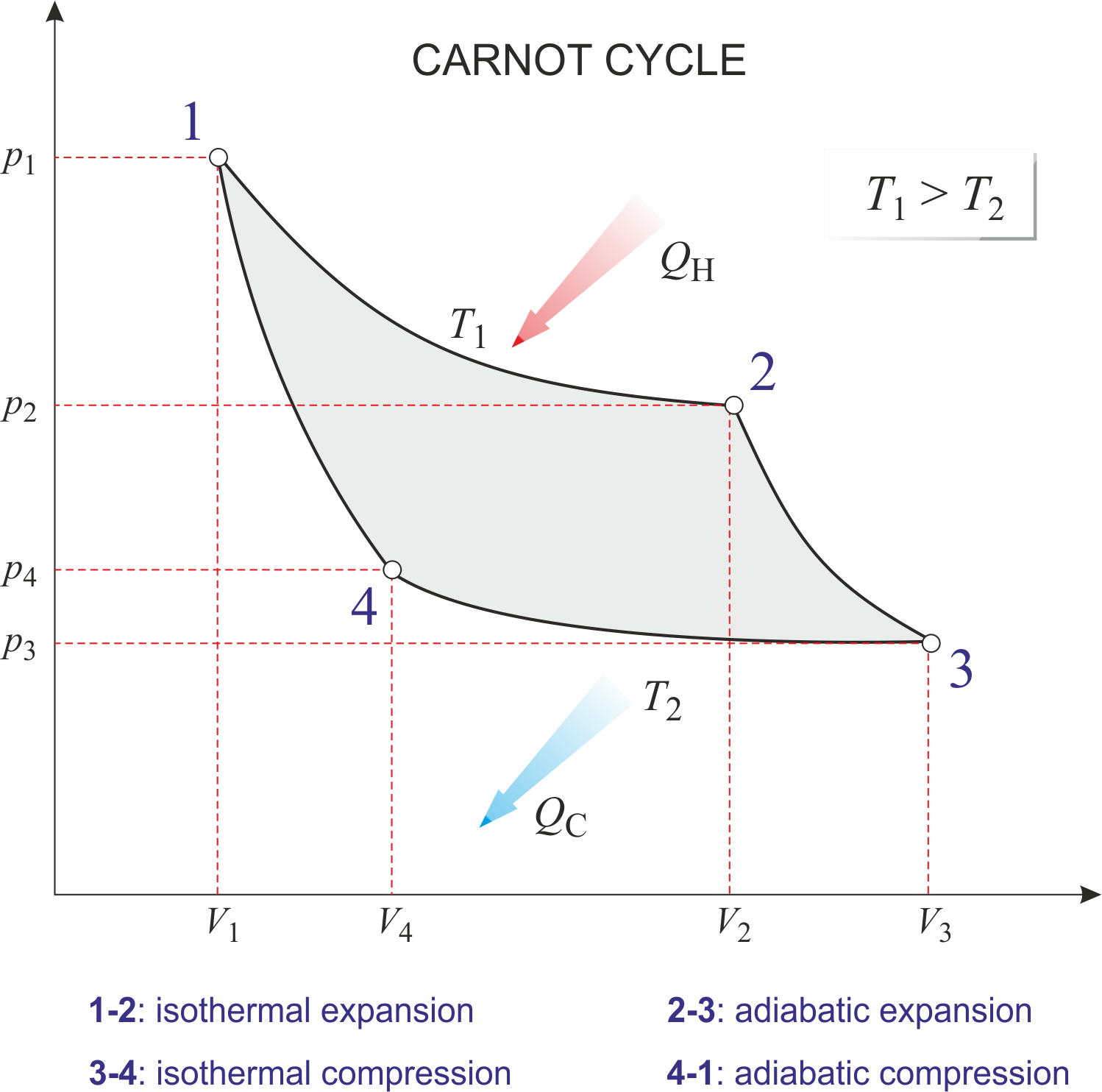
Carnot cycle is the most efficient cycle of operations for a reversible heat engine. Published in 1824 by French physicist Nicolas Léonard Sadi Carnot (1796-1832), it consists of four operations on the working substance in the engine:
1-2: Isothermal expansion at thermodynamic temperature T1 with heat QH taken in.
2-3: Adiabatic expansion with a fall of temperature to T2.
3-4: Isothermal compression at temperature T2 with heat QC given out.
4-1: Adiabatic compression at temperature back to T1.
According to the Carnot principle, the efficiency of any reversible heat engine depends only on the temperature range through which it works, rather than the properties of the working substances.
catalyst → katalizator
Catalyst is a substance that increases the rate of a chemical reaction without itself undergoing any permanent chemical change. Catalysts that have the same phase as the reactants are homogenous catalysts (e.g. enzymes in biochemical reactions). Those that have a different phase are heterogeneous catalyst (e.g. metals or oxides used in gas reactions).
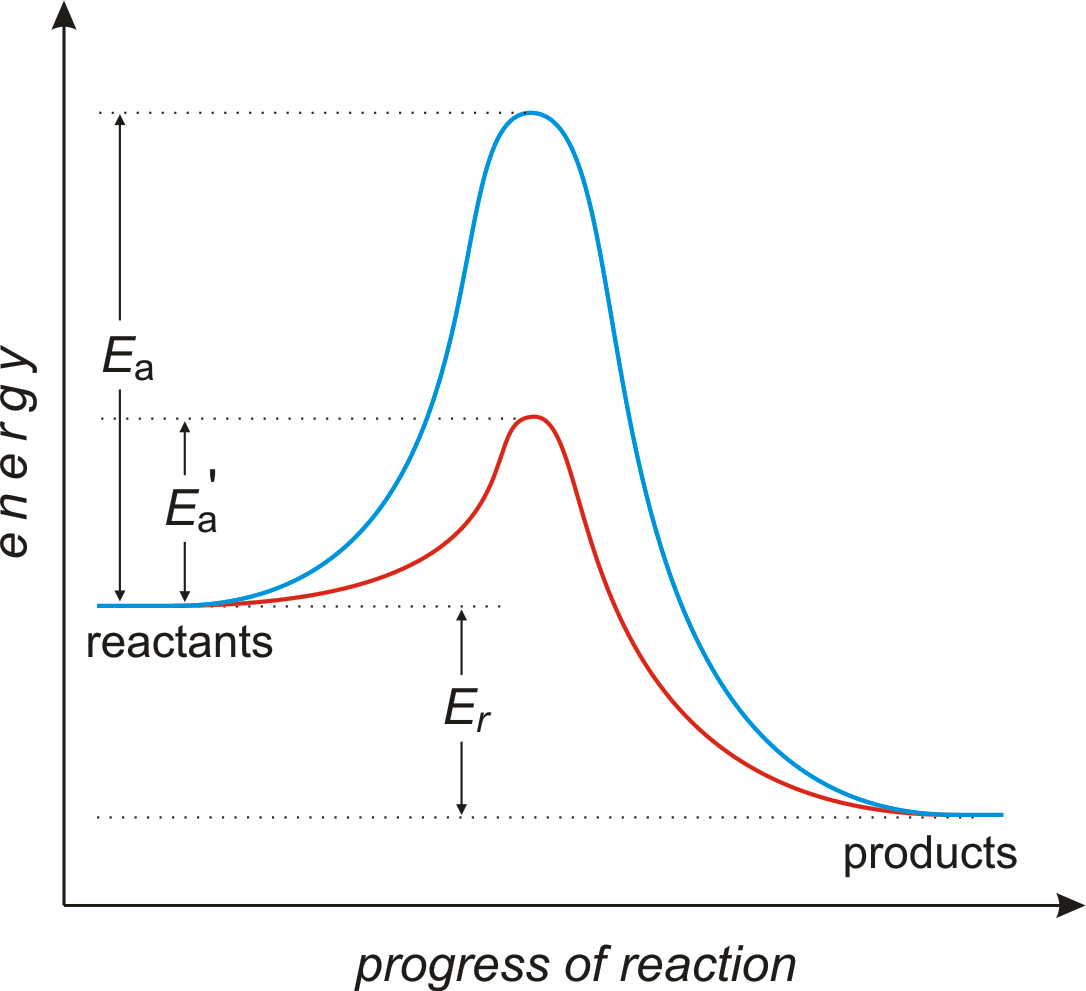
The catalyst provides an alternative pathway by which the reaction can proceed, in which the activation energy is lower. In thus increases the rate at which the reaction comes to an equilibrium, although it does not alter the position of the equilibrium.
catalytic cracking → katalitčko krekiranje
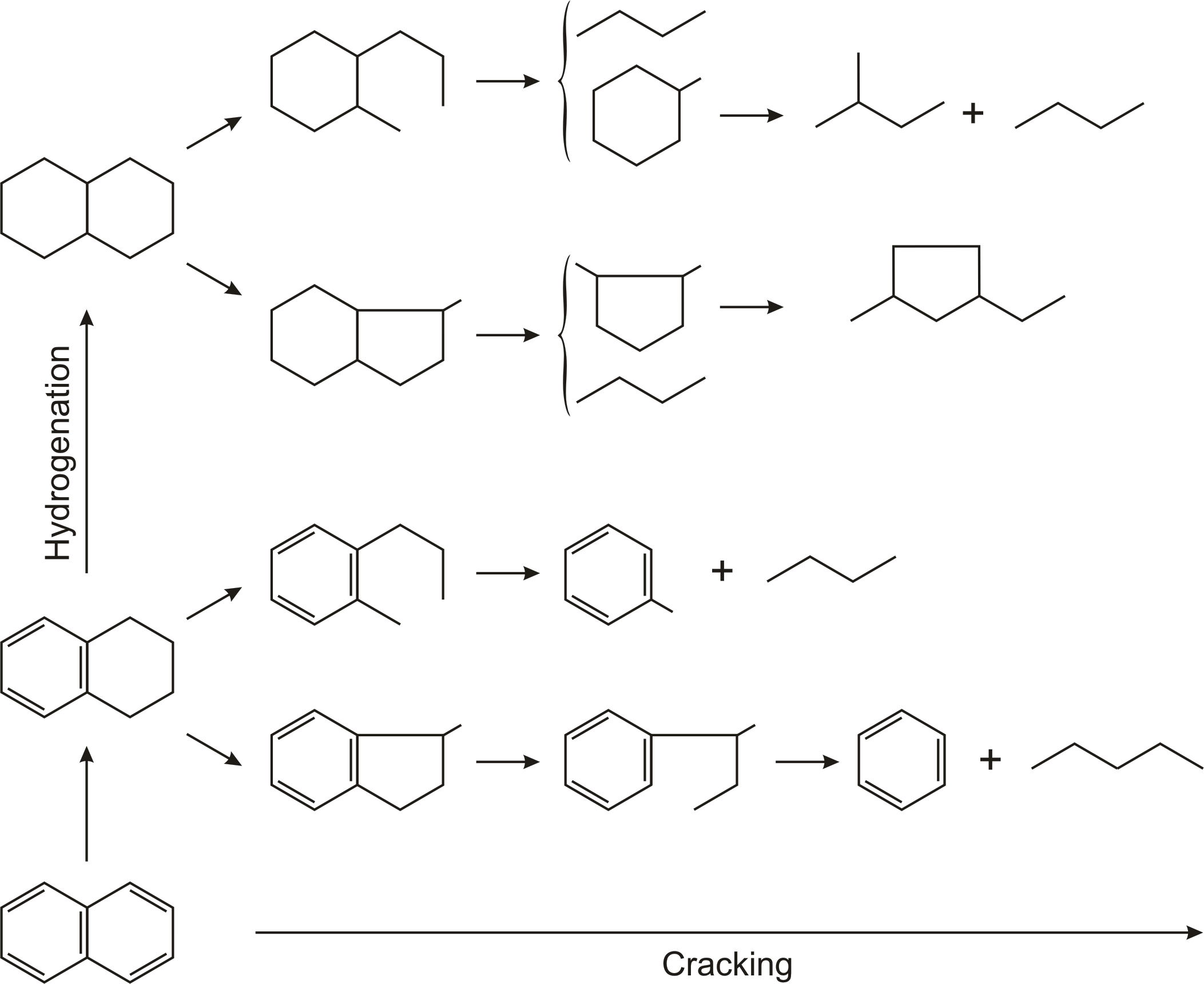
Catalytic cracking is a petroleum refining process in which heavy-molecular weight hydrocarbons are broken up into light hydrocarbon molecules by the application of heat and pressure in the presence of a catalyst.
critical volume → kritični volumen
Critical volume is the volume of a fixed mass of a fluid at critical temperature and pressure.
cryoscopic constant → krioskopska konstanta
Cryoscopic constant (Ef) is the constant that expresses the amount by which the freezing point Tf of a solvent is lowered by a non-dissociating solute, through the relation
where m is the molality of the solute.
crystal → kristal
Crystal is a solid with a regular geometric shape, having a characteristic internal structure and enclosed by symmetrically arranged plane surfaces, intersecting at definite and characteristic angles. In crystals the particles (atoms, ions, or molecules) have a regular three-dimensional repeating arrangement in space. This is called the crystal structure. The crystal lattice is the arrangement of points in space at which the particles are positioned.
cathode → katoda
Cathode is a negative electrode of an electrolytic cell to which positively charged ions (cations) migrate when a current is passed as in electroplating baths.
In a primary or secondary cell (battery or accumulator) the cathode is the electrode that spontaneously becomes negative during discharge, and form which therefore electrons emerge.
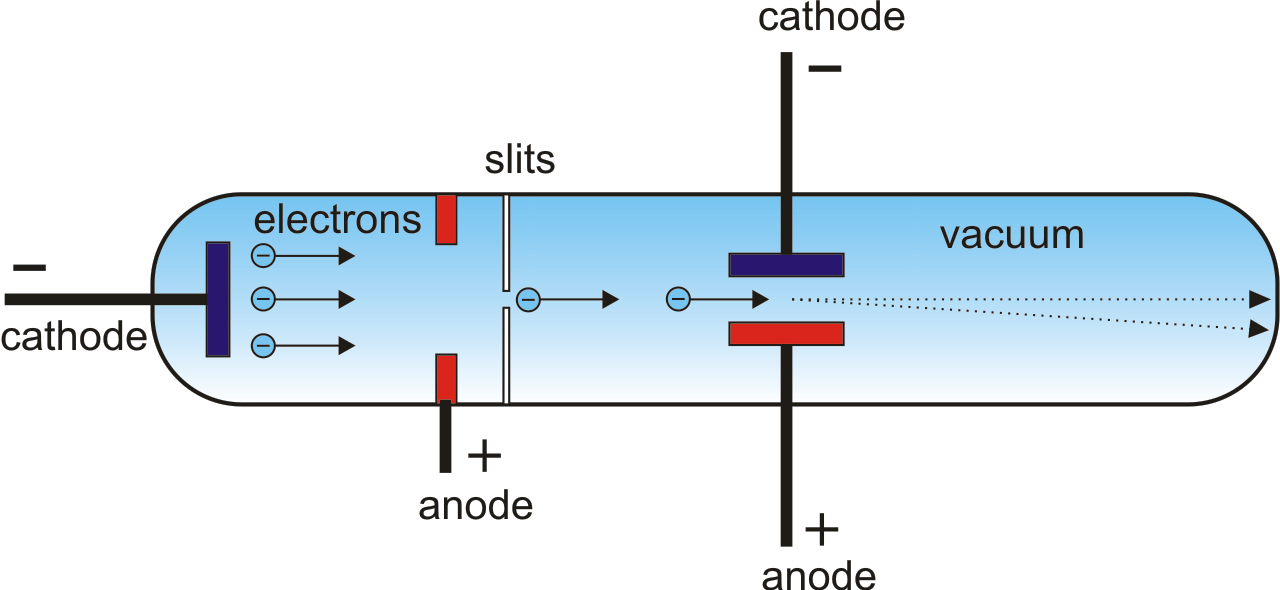
In vacuum electronic devices electrons are emitted by the cathode and flow to the anode.
cathode ray → katodna zraka
Cathode ray is a negatively charged beam that emanates from the cathode of a discharge tube. Cathode rays are streams of electrons.
Citing this page:
Generalic, Eni. "S.t.p.." Croatian-English Chemistry Dictionary & Glossary. 29 June 2022. KTF-Split. {Date of access}. <https://glossary.periodni.com>.


 English


