
CHEMISTRY GLOSSARY
extensive property → ekstenzivno svojstvo
Extensive property is a property that changes when the amount of matter in a sample changes. Examples are mass, volume, length, and charge.
critical point → kritična točka
In general, critical point is the point on the phase diagram of a two-phase system at which the two coexisting phases have identical properties and therefore represent a single phase. At the liquid-gas critical point of a pure substance, the distinction between liquid and gas vanishes, and the vapour pressure curve ends. The coordinates of this point are called the critical temperature and critical pressure. Above the critical temperature it is not possible to liquefy the substance.

critical pressure → kritični tlak
Critical pressure is the pressure of a fluid in its critical point; i.e. when it is at its critical temperature and critical volume.
cubic close-packed structure → kubična gusta slagalina
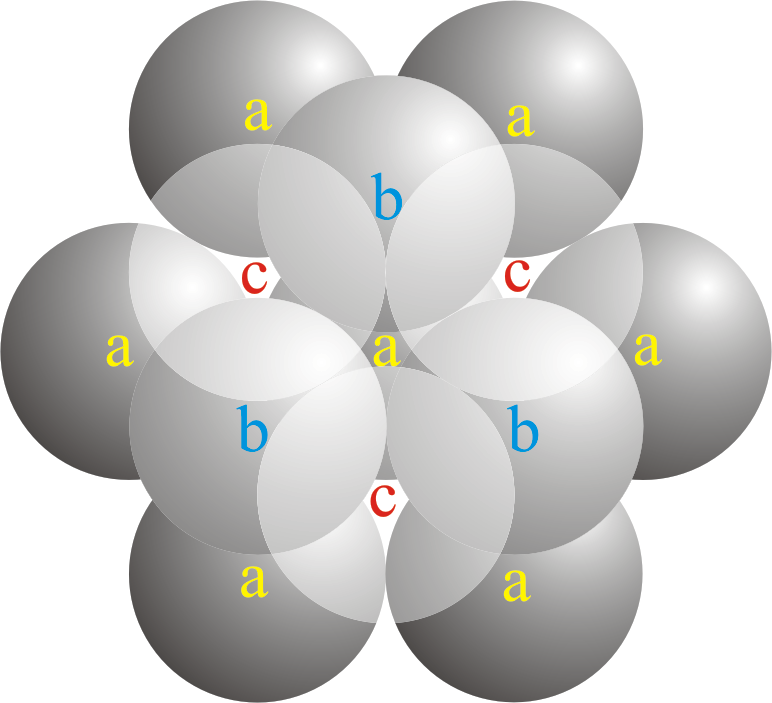
In a cubic close-packed (ccp) arrangement of atoms, the unit cell consists of four layers of atoms. The top and bottom layers (a) contain six atoms at the corners of a hexagon and one atom at the center of each hexagon. The atoms in the second layer (b) fit into depressions in the first layer. The atoms in the third layer (c) occupy a different set of depressions than those in the first. The cubic close packed structure can be made by piling layers in the a-b-c-a-b-c-a-b-c... sequence.
flash point → temperatura zapaljenja
Flash point is the lowest temperature at which a liquid or volatile solid gives off vapour sufficient to form an ignitable mixture with the air near the surface of the liquid or within the test vessel (NFPA).
freezing point → ledište
Freezing point is the temperature at which a liquid becomes a solid at normal atmospheric pressure.
See Melting point
Heisenberg uncertainty principle → Heisenbergov princip neodređenosti
Heisenberg uncertainty principle is the principle that it is not possible to know with unlimited accuracy both the position and momentum of a particle. The German physicist Werner Heisenberg (1901-1976) discovered this principle in 1927.
high-density polyethylene → polietilen visoke gustoće
High-density polyethylene (HDPE) is a thermoplastic polyolefin with a density of from 0.941 g/cm3 to 0.960 g/cm3. It is a recyclable plastic, used for items such as milk containers, detergent containers, and base cups of plastic soft drink bottles. HDPE has a high degree of resistance to chemicals, is easy to keep clean, and easily welded.
horse power → konjska snaga
Horse power is an obsolete non-SI of power introduced by James Watt in 1782 to allow describing the power of steam machinery. It was equal to the work effort of a horse needed to raise vertically 528 cubic feet of water to one metre in one minute (HP = 735.498750 W).
Citing this page:
Generalic, Eni. "S.t.p.." Croatian-English Chemistry Dictionary & Glossary. 29 June 2022. KTF-Split. {Date of access}. <https://glossary.periodni.com>.


 English

