
CHEMISTRY GLOSSARY
allotropic modification → alotropska modifikacija
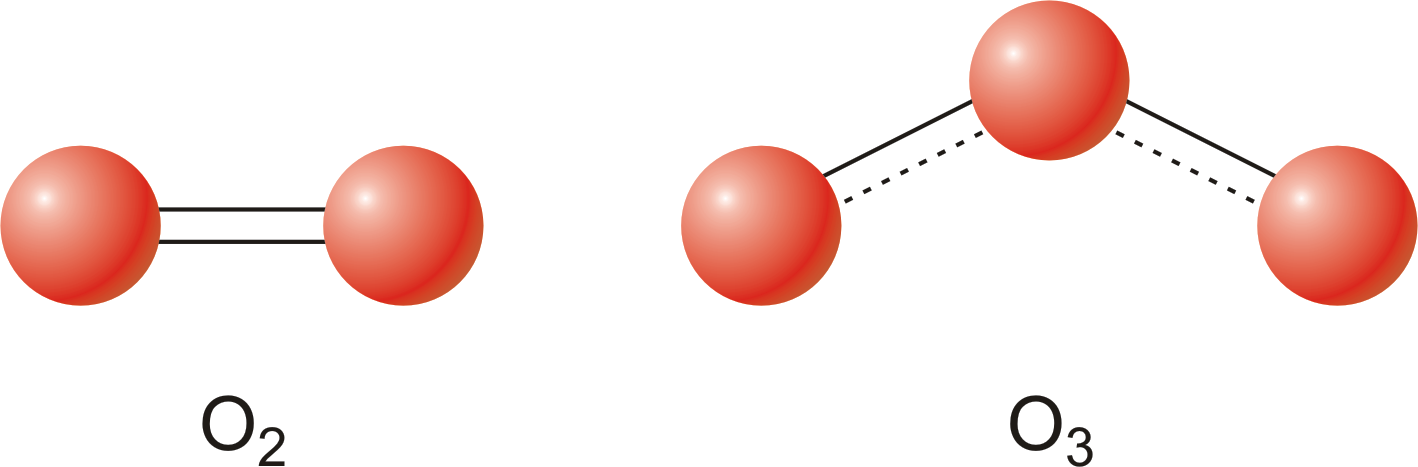
Different substances of the same elementary system are called allotropes or allotropic modifications. In the case of oxygen, there are two allotropic modifications: "normal" dioxygen (O2) and trioxygen (O3) or ozone.
allotropy → alotropija
Allotropy (Gr. allos, other, and tropos, manner) is the phenomenon of an element existing in two or more physical forms in the same physical state. The difference between the forms involves either crystaline structure (white, red and black phosphorus), the number of atoms in the molecule of a gas (diatomic oxygen and triatomic ozone), or the molecular structure of a liquid (liquid helium an helium II).
In some cases, the allotropes are stable over a temperature range, with a definite transition point at which one changes into the other. For instance, tin has two allotropes: white (metallic) tin stable above 13.2 °C and grey (nonmetallic) tin stable below 13.2 °C. This form allotropy is called enantiotropy. Form of allotropy, in which there is no transition temperature at which the two are in equilibrium, is called monotropy.
Allotropy does not apply to the substance existing in different physical states as, for example, when ice melts and changes from solid ice to liquid water.
Allotropy is generally restricted to describing polymorphic behaviour in elements, while polymorphism may refer to any material having multiple crystal structures.
alpaca → alpaka
Alpaca (alpaka) or Nickel Silver is the generic name for any of a range of non-precious bright silvery-grey metal alloys, composed of copper, nickel and zinc. Despite its name it contains no real silver. It is also commonly called German Silver.
There are many different formulations of alloys which fall within the general term of Nickel Silver. All contain copper, nickel and zinc, while some formulations may additionally include antimony, tin, lead or cadmium. A representative formulation is 65 % copper, 18 % nickel, 17 % zinc. Nickel Silver is widely used for the commercial production of industrial components, housewares, flatware and cutlery, and as the metal substrate for silver-plated goods.
anion exchange → anionski izmjenjivač
An anionic resin has negative ions built into its structure and therefore exchanges positive ions. In an anion exchange, the side groups are ionised basic groups, such as (-NH2, -NRH, -NR2, -NR3+) to which anions OH- are attached. The exchange reaction is one in which different anions in the solution displace the OH- from the solid.
anisotropic crystal → anizotropni kristal
Anisotropic crystal is a crystal that exhibits different properties when tested along axes in different directions.
anisotropy → anizotropija
Anisotropy is the property of molecules and materials to exhibit variations in physical properties along different molecular axes of the substance.
anodising → anodizacija
Anodising is a method of coating objects made of aluminium with a protective oxide film, by making them the anode in an electrolytic bath containing an oxidising electrolyte. Anodising can also be used to produce a decorative finish by formation of an oxide layer that can absorb a coloured dye.
antifreeze → antifriz
Antifreeze is a substance added to the liquid (usually water) in the cooling systems of internal-combustion engines to lower its freezing point so that it does not solidify at sub-zero temperatures. The commonest antifreeze is ethane- 1.2-diol (ethylene glycol).
Citing this page:
Generalic, Eni. "S.t.p.." Croatian-English Chemistry Dictionary & Glossary. 29 June 2022. KTF-Split. {Date of access}. <https://glossary.periodni.com>.


 English