
CHEMISTRY GLOSSARY
stabiliser → stabilizator
Stabiliser is a substance that makes a mixture more stable. Antioxidants and antiozonants are examples of stabilisers; stabilisers are added to paints to prevent the components of the mixture from separating over time.
standard mean ocean water → standardna prosječna oceanska voda
Standard mean ocean water (SMOW) is a standard sample of pure water of accurately known isotopic composition which is maintained by the International Atomic Energy Agency. It is used for precise calibration of density and isotopic composition measurements.
standardisation → standardizacija
Standardisation is a process of determining the exact concentration of secondary standard solution.
standing wave → stojni val
Standing waves occur when a travelling wave reflects from the fixed ends of a string, producing other waves moving in opposite direction. They are called standing waves because the energy in the string cannot move past the fixed ends, i.e. it stands in the string. In real strings, after some time, standing waves are eventually damped due to friction.
orthorhombic crystal system → ortorompski kristalni sustav
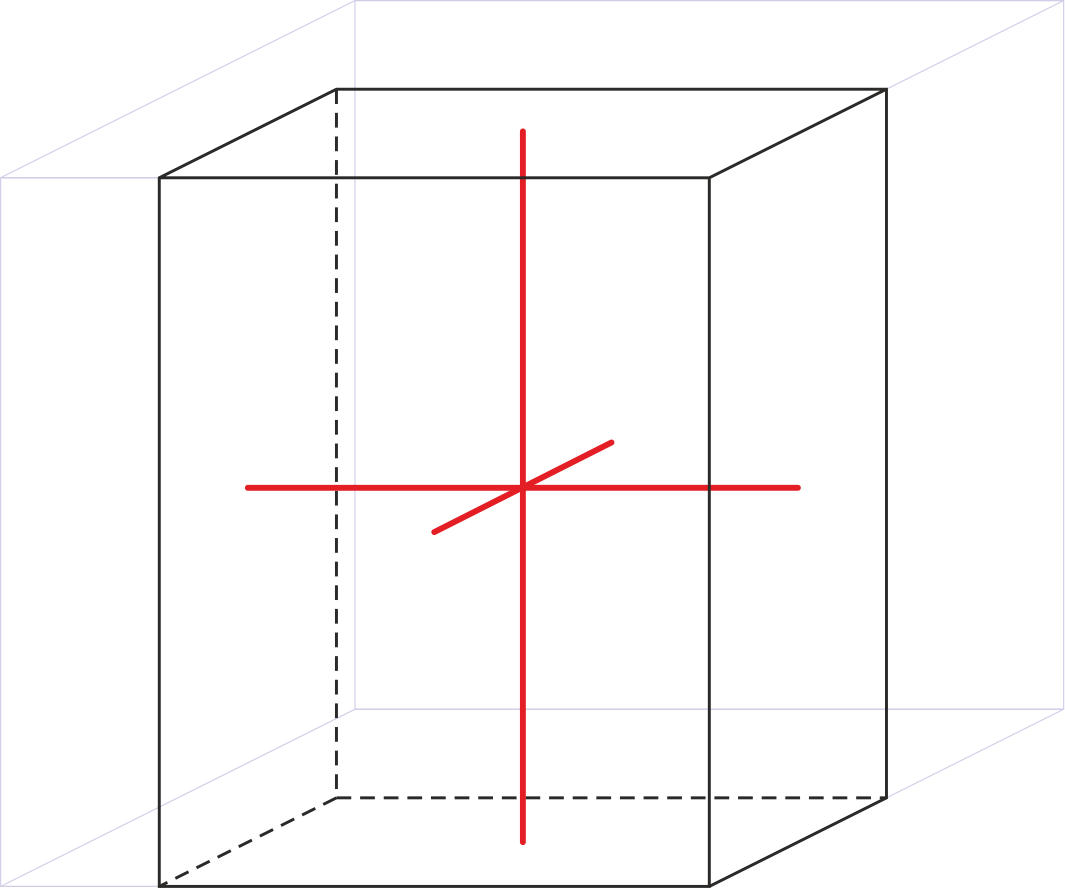
Orthorhombic crystal system is also known as the rhombic system. Minerals of the orthorhombic crystal system are referred to three mutually perpendicular axes, each of which is of a different length than the others.
a ≠ b ≠ c
α = β = γ = 90°
osmium → osmij
Osmium was discovered by Smithson Tennant (England) in 1803. The origin of the name comes from the Greek word osme meaning smell. It is hard fine black powder or hard, lustrous, blue-white metal. Unaffected by air, water and acids. Characteristic acrid, chlorine like odour due to tetroxide compound. Osmium tetroxide highly toxic. Osmium is obtained from the same ores as platinum. Used to tip gold pen points, instrument pivots, to make electric light filaments. Used for high temperature alloys and pressure bearings. Very hard and resists corrosion better than any other.
stereospecific reaction → stereospecifična reakcija
Stereospecific reactions are reactions that proceed predominantly to a single stereoisomeric product out. All metabolic conversions involving chiral molecules are stereospecific.
substrate → supstrat
1. Substrate is a surface upon which an organism grows, sometimes by using chemicals of particles in the material as food
2. Substrate is a substance that is acted upon by an enzyme during a biochemical reaction.
3. Substrate is the material or product that is to be coated (for example, paint or laminate.).
superconductivity → supravodljivost
Superconductivity is the phenomenon in which certain metals, alloys, and compounds below a certain temperature, the transition point (Tc), lose electrical resistance and magnetic permeability, i.e. have infinite electrical conductivity (Meissner effect and Josephson effect).
Citing this page:
Generalic, Eni. "S.t.p.." Croatian-English Chemistry Dictionary & Glossary. 29 June 2022. KTF-Split. {Date of access}. <https://glossary.periodni.com>.


 English