
CHEMISTRY GLOSSARY
depression of freezing point → snižavanje ledišta
Depression of freezing point of a pure solvent is observed when substances are dissolved in it. The amount by which the freezing point is depressed is proportional to the number of molecules of solute and independent of their nature.
dissolved substance → otopljena tvar
Dissolved substance is a solid, liquid or gas matter dissolved in a solvent. Depending upon the particle size of dissolved substance, solutions differ in properties and can be divided into real solutions (diameter of particles is smaller than 1 nm), colloid solutions (diameter of particles is from 1 nm to 200 nm) and suspensions (diameter of particles is greater than 200 nm).
ebullioscopic constant → ebulioskopska konstanta
Ebullioscopic constant (Eb) is the constant that expresses the amount by which the boiling point Tb of a solvent is raised by a nondissociating solute, through the relation
where b is the molality of the solute.
fractional crystallisation → frakcijska kristalizacija
Fractional crystallisation is a method of separating a mixture of soluble solids by dissolving them in a suitable hot solvent and then lowering the temperature slowly. The least soluble component will crystallise out first, leaving the other components in the solution. By controlling the temperature, it is sometimes possible to remove each component in turn.
dielectric constant → dielektrična konstanta
Dielectric constant or permittivity (ε) is an index of the ability of a substance to attenuate the transmission of an electrostatic force from one charged body to another. The lower the value, the greater the attenuation. The standard measurement apparatus utilises a vacuum whose dielectric constant is 1. In reference to this, various materials interposed between the charged terminal have the following value at 20 °C:
| vacuum | 1 |
| air | 1.00058 |
| glass | 3 |
| benzene | 2.3 |
| acetic acid | 6.2 |
| ammonia | 15.5 |
| ethanol | 25 |
| glycerol | 56 |
| water | 81 |
The exceptionally high value for water accounts for its unique behaviour as a solvent and in electrolytic solutions. Dielectric constant values decrease as the temperature rises.
dissociation → disocijacija
Dissociation is the process by which a chemical combination breaks up into simpler constituents as a result of either added energy (dissociated by heat), or the effect of a solvent on a dissolved polar compound (electrolytic dissociation). It may occur in the gaseous, solid, or liquid state, or in a solution.
An example of dissociation is the reversible reaction of hydrogen iodide at high temperatures
The term dissociation is also applied to ionisation reactions of acids and bases in water. For example
which is often regarded as a straightforward dissociation into ions
extraction → ekstrakcija
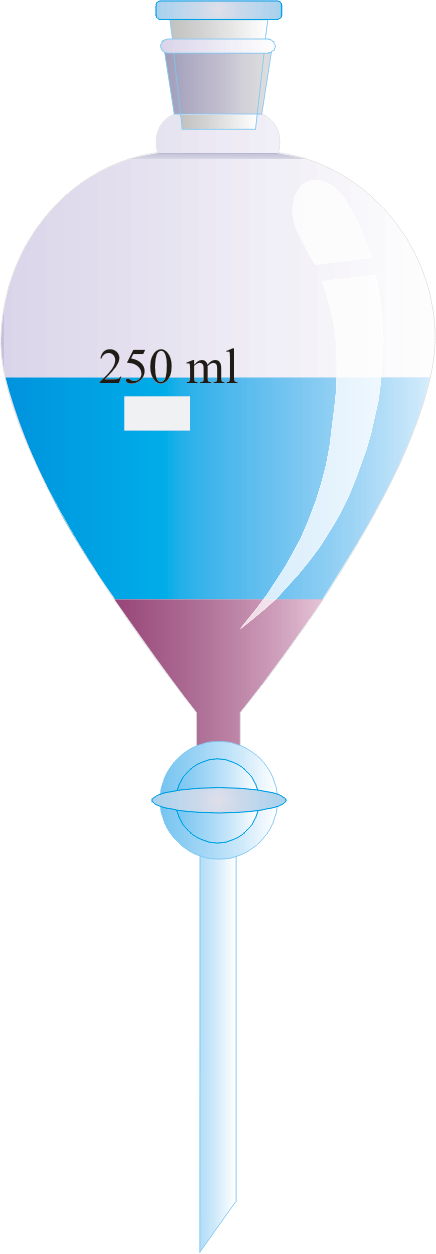
Extraction is the separation of a component from its mixture by selective solubility. When a solution of one substance in one solvent is brought in with another solvent dissolved substance will distribute between the two solutants because of different solubility. Extraction is an efficient and fast method used for separating and concentrating matters. Extraction is best done several times in a succession, with smaller amount of solvent in it the matter is better dissolved. For example, caffeine can be separated from coffee beans by washing the beans with supercritical fluid carbon dioxide; the caffeine dissolves in the carbon dioxide, but flavour compounds do not. Vanillin can be extracted from vanilla beans by shaking the beans with an organic solvent, like ethanol.
insoluble substance → netopljiva tvar
Insoluble substance is a substance that does not dissolve in a solvent to give a reasonable concentration (e.g. chalk is insoluble in water).
freon → freon
Freon (chlorofluorocarbon, CFC) a type of compound in which some or all of the hydrogen atoms of hydrocarbon (usually an alkane) have been replaced by chlorine and fluorine atoms. Most CFC are chemically uncreative and are stable at high temperatures. They are used as aerosol propellants, refrigerants, and solvents, and in the manufacture of rigid packaging foam. CFC because of their chemical inertness, can diffuse unchanged into the upper atmosphere. Here, photochemical reactions cause them to break down and react with ozone. For his reason, their use has been discouraged.
glycine → glicin
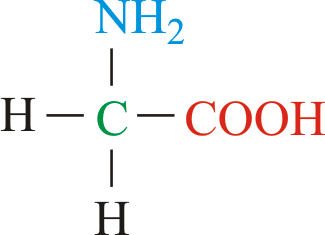
Glycine is the smallest amino acid and is unique because it lacks a side chain. This gives it more conformational freedom than any other amino acid. Glycine is often found in turns and loops where other amino acids would be sterically unacceptable. Although it is formally nonpolar, it’s very small side chain makes no real contribution to hydrophobic interactions. Glycine is not essential to the human diet, as it is biosynthesized in the body from the amino acid serine.
- Abbreviations: Gly, G
- IUPAC name: 2-aminoacetic acid
- Molecular formula: C2H5NO2
- Molecular weight: 75.07 g/mol
Citing this page:
Generalic, Eni. "Nonpolar solvent." Croatian-English Chemistry Dictionary & Glossary. 29 June 2022. KTF-Split. {Date of access}. <https://glossary.periodni.com>.


 English
