
CHEMISTRY GLOSSARY
solubility curve → krivulja topljivosti
Solubility curve is a graphic presentation of solubility change in dependence on temperature.
solubility → topljivost
Solubility is the maximum amount of solute that dissolves in a given quantity of solvent at a specific temperature. Generally, for a solid in a liquid, solubility increases with temperature; for a gas, solubility decreases. Common measures of solubility include the mass of solute per unit mass of solution (mass fraction), mole fraction of solute, molality, molarity, and others.
solubility product constant → konstanta produkta topljivosti
Solubility product constant (Ksp) (or the solubility product) is the product of the molar concentrations of the constituent ions, each raised to the power of its stoichiometric coefficient in the equilibrium equation. For instance, if a compound AaBb is in equilibrium with its solution
the solubility product is given by
conversion factor → konverzijski faktor
Conversion factor is a fraction that relates one unit to another. Multiplying a measurement by a conversion factor changes the units of the measurement, for example
gravimetrical factor → gravimetrijski faktor
Gravimetrical factor is stechiometric proportion between molar mass of analyte and molar mass of precipitate in gravimetry.
retardation factor → faktor zaostajanja
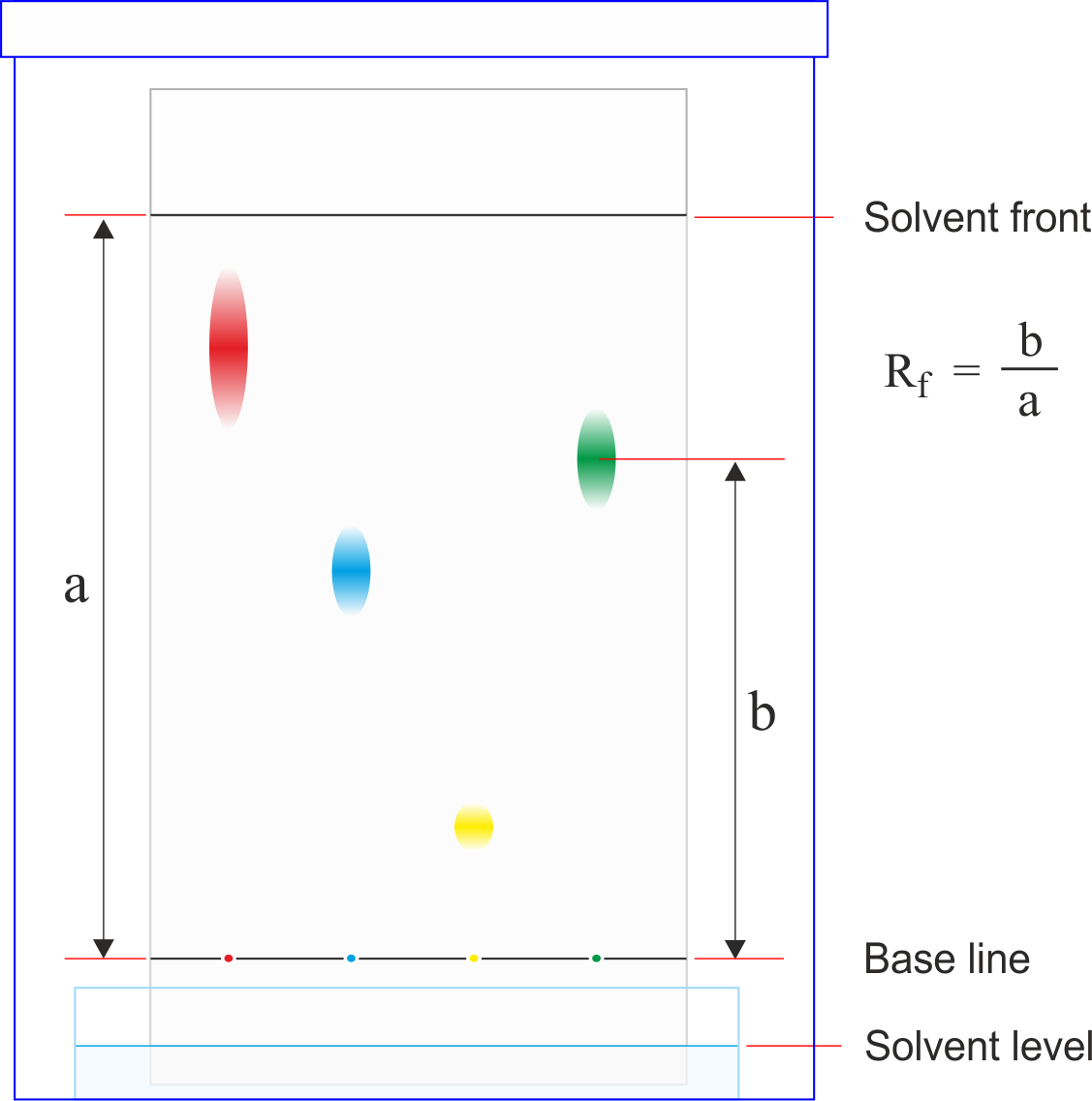
Retardation factor, RF, (in planar chromatography) is a ratio of the distance travelled by the centre of the spot to the distance simultaneously travelled by the mobile phase:
The RF value is characteristic for any given compound on the same stationary phase using the same mobile phase for development of the plates. Hence, known RF values can be compared to those of unknown substances to aid in their identifications.
absorptance → apsorptancija
Absorptance (α) is the ratio of the radiant or luminous flux in a given spectral interval absorbed in a medium to that of the incident radiation. Also called absorption factor.
aspartic acid → asparaginska kiselina
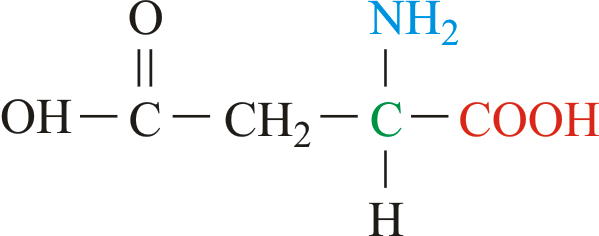
Aspartic acid is an electrically charged amino acids with acidic side chains. As a group the charged amino acids are relatively abundant and are generally located on the surface of the protein. Aspartic acid and glutamic acid play important roles as general acids in enzyme active centers, as well as in maintaining the solubility and ionic character of proteins. Aspartic acid (sometimes referred to as asparate depending on pH) is non-essential in mammals, being produced from oxaloacetate by transamination.
- Abbreviations: Asp, D
- IUPAC name: 2-aminobutanedioic acid
- Molecular formula: C4H7NO4
- Molecular weight: 133.10 g/mol
biocapacity → biokapacitet
Biocapacity (or biological capacity) is the capacity of ecosystems to produce useful biological materials and to absorb carbon dioxide generated by humans, using current management schemes and extraction technologies. Useful biological materials are defined as those used by the human economy, hence what is considered useful can change from year to year. The biocapacity of an area is calculated by multiplying the actual physical area by the yield factor and the appropriate equivalence factor.
Yield factor is a factor that accounts for differences between countries in productivity of a given land type. Each country and each year has yield factors for cropland, grazing land, forest, and fisheries.
Equivalence factor is a productivity based scaling factor that converts a specific land type into a universal unit of biologically productive area, a global hectare (gha).
chromatography → kromatografija
Chromatography is a method of separation of the components of a sample in which the components are distributed between two phases, one of which is stationary while the other moves. In gas chromatography, the gas moves over a liquid or solid stationary phase. In liquid chromatography, the liquid mixture moves through another liquid, a solid, or a gel. The mechanism of separation of components may be adsorption, differential solubility, ion-exchange, permeation, or other mechanisms.
Citing this page:
Generalic, Eni. "Factors affecting solubility." Croatian-English Chemistry Dictionary & Glossary. 29 June 2022. KTF-Split. {Date of access}. <https://glossary.periodni.com>.


 English

