
CHEMISTRY GLOSSARY
voltametry → voltametrija
Voltametry is a common name for a large group of instrumental techniques which are based on measuring the electric current formed by a continuous potential shifting on the electrodes.
groups in periodic system of elements → skupine periodnog sustava
Periodic system of elements is divided into 18 groups of chemical elements. Elements belonging to the same group have a same number of valence electrons and similar chemical properties. Elements of main groups are in 1., 2., and in groups 13. to 18. Different groups of elements can be named according to the first element in the group (elements of boron group, elements of carbon group), or they have some special names (noble gases, halogenic elements, halyde elements, earthalkali and alkali metals).
half-wave potential → poluvalni potencijal
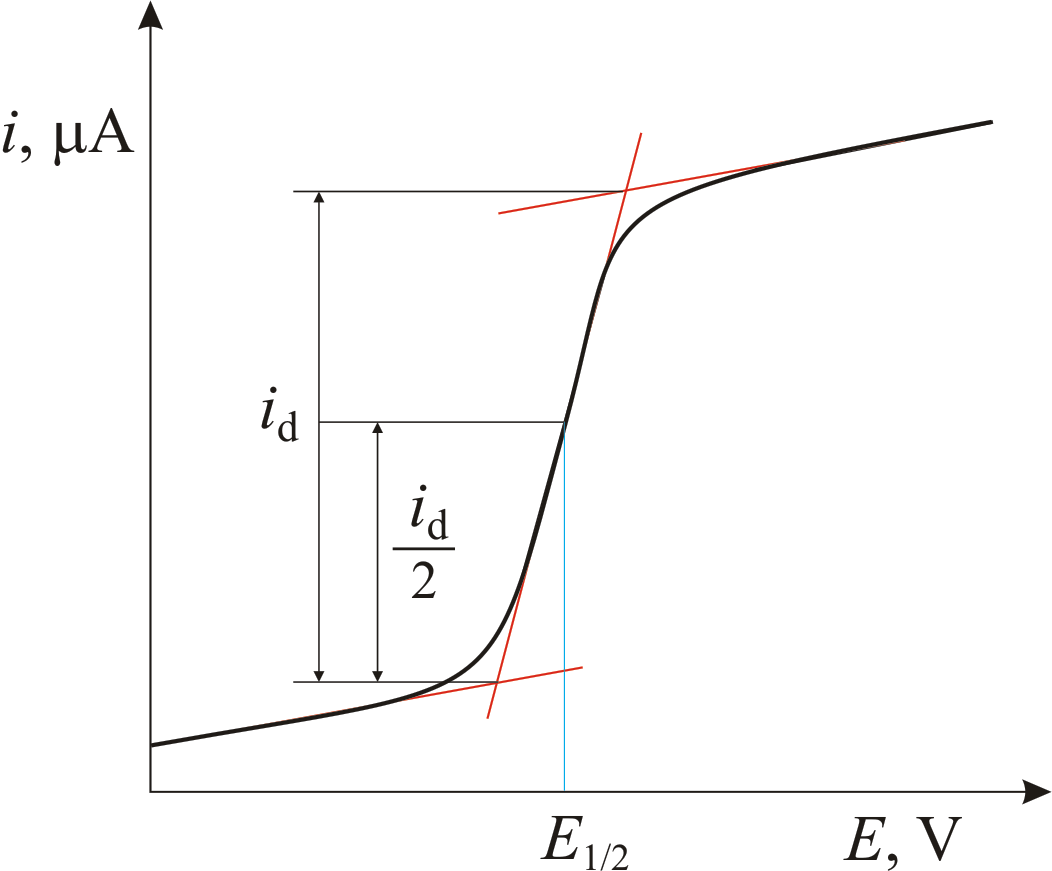
Half-wave potential (E1/2) is a potential at which polarographic wave current is equal to one half of diffusion current (id). In a given supporting electrolyte, the half-wave potential is unique for each element and its different valence states and chemical forms. Observation of a current peak at a specific half-wave potential therefore identifies the chemical species producing the current.
halogens → halogeni elementi
Halogens are the elements fluorine (F) chlorine (Cl), bromine (Br), iodine (I), and astatine (At). They are non-metals, and make up part of the 17 group in the periodic table. Compounds of these elements are called halogenides or halides.
The halogens all have a strong unpleasant odour and will burn flesh. They do not dissolve well in water. The five elements are strongly electronegative. They are oxidising agents, with fluorine being the strongest and astatine being the weakest. They react with most metals and many non-metals.
Halogens form molecules which consist of atoms covalently bonded. With increasing atomic weight there is a gradation in physical properties. For example: Fluorine is a pale green gas of low density. Chlorine is a greenish-yellow gas 1.892 times as dense as fluorine. Bromine is a deep reddish-brown liquid which is three times as dense as water. Iodine is a grayish-black crystalline solid with a metallic appearance. And astatine is a solid with properties which indicate that it is somewhat metallic in character.
heavy water → teška voda
Water molecules are composed of two hydrogen atoms and one oxygen atom (H2O). If the hydrogen atoms of a water molecule are replaced by deuterium atoms, the result is heavy water (D2O). Deuterium differs from hydrogen by having one neutron in the nucleus of the atom. There is approx. one part in 5000 D2O in normal water and it can be concentrated by electrolysis. Heavy water has a higher boiling point (101.4 °C) and melts at 3.6 °C. Heavy water is 20/18=1.11 times heavier than ordinary water.
wave-particle duality → valno-čestična dualnost
Wave-particle duality is an observation that electrons, photons, and other very small entities behave like particles in some experiments and like waves in others.
wavefunction → valna funkcija
Wavefunction (Ψ) is a mathematical function that gives the amplitude of a wave as a function of position (and sometimes as a function of time and/or electron spin). Wavefunctions are used in chemistry to represent the behaviour of electrons bound in atoms or molecules.
wavelength → valna duljina
Wavelength is the distance between two neighbouring peaks of the electromagnetic wave.
weak base → slaba baza
Weak base is a base that only partially dissociates into ions in solution. Weak bases are weak electrolytes. Ammonia is an example of a weak base
Citing this page:
Generalic, Eni. "Elektron." Croatian-English Chemistry Dictionary & Glossary. 29 June 2022. KTF-Split. {Date of access}. <https://glossary.periodni.com>.


 English