
CHEMISTRY GLOSSARY
metalloid → polumetal
Metalloid (semimetal) is any of a class of chemical elements intermediate in properties between metals and nonmetals. The classification is not clear cut, but typical metalloids are boron (B), silicon (Si), germanium (Ge), arsenic (As), and tellurium (Te). They are electrical semiconductors and their oxides are amphoteric.
micelle → micele
Micelle is an electrically charged colloidal particle, usually organic in nature, composed of aggregates of large molecules, e.g., in soaps and surfactants. For aqueous solutions, the hydrophilic end of the molecule is on the surface of the micelle, while the hydrophobic end (often a hydrocarbon chain) points toward the centre.
mucopolysaccharide → mukopolisaharid
Mucopolysaccharides are carbohydrates that can be found in cellular membranes of bacteria.
negative pole → negativan pol
Negative pole is that half-cell in electrochemical cell that has the most negative electrode potential.
calomel electrode → kalomel elektroda
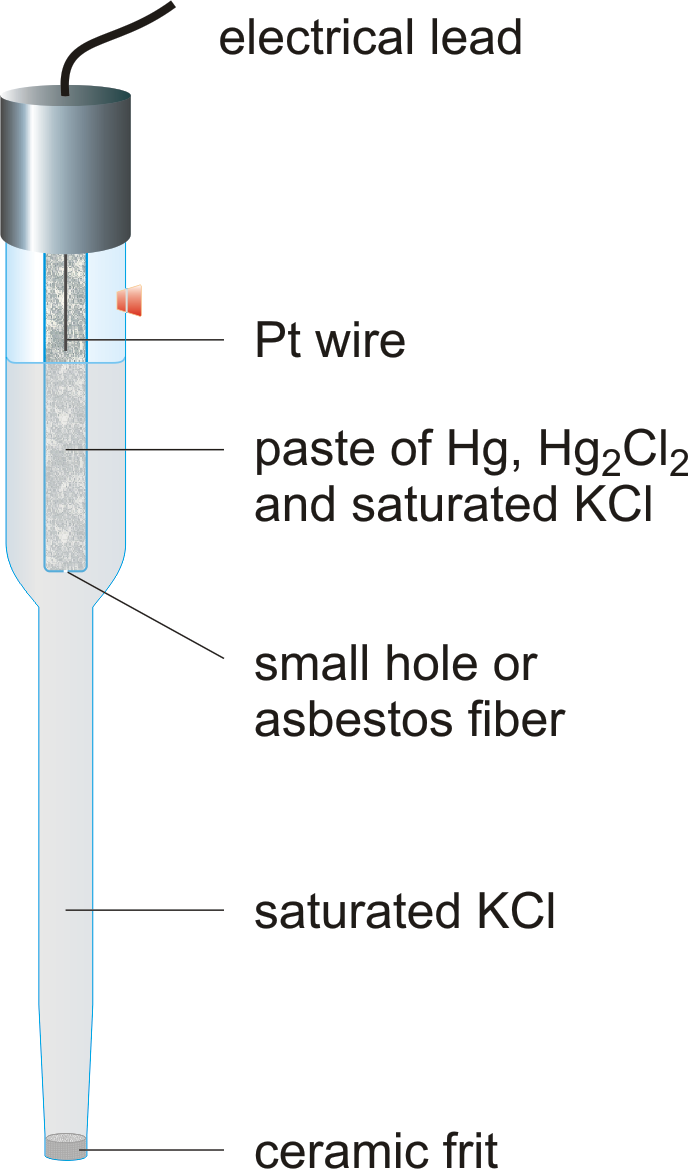
Calomel electrode is a type of half cell in which the electrode is mercury coated with calomel (Hg2Cl2) and the electrolyte is a solution of potassium chloride and saturated calomel. In the calomel half cell the overall reaction is
Table: Dependence of potential of calomel electrode upon temperature and concentration of KCl according to standard hydrogen electrode
| Potential vs. SHE / V | |||
|---|---|---|---|
| t / °C | 0.1 mol dm-3 | 3.5 mol dm-3 | sat. solution |
| 15 | 0.3362 | 0.254 | 0.2511 |
| 20 | 0.3359 | 0.252 | 0.2479 |
| 25 | 0.3356 | 0.250 | 0.2444 |
| 30 | 0.3351 | 0.248 | 0.2411 |
| 35 | 0.3344 | 0.246 | 0.2376 |
cathode → katoda
Cathode is a negative electrode of an electrolytic cell to which positively charged ions (cations) migrate when a current is passed as in electroplating baths.
In a primary or secondary cell (battery or accumulator) the cathode is the electrode that spontaneously becomes negative during discharge, and form which therefore electrons emerge.
In vacuum electronic devices electrons are emitted by the cathode and flow to the anode.
cathodic protection → katodna zaštita
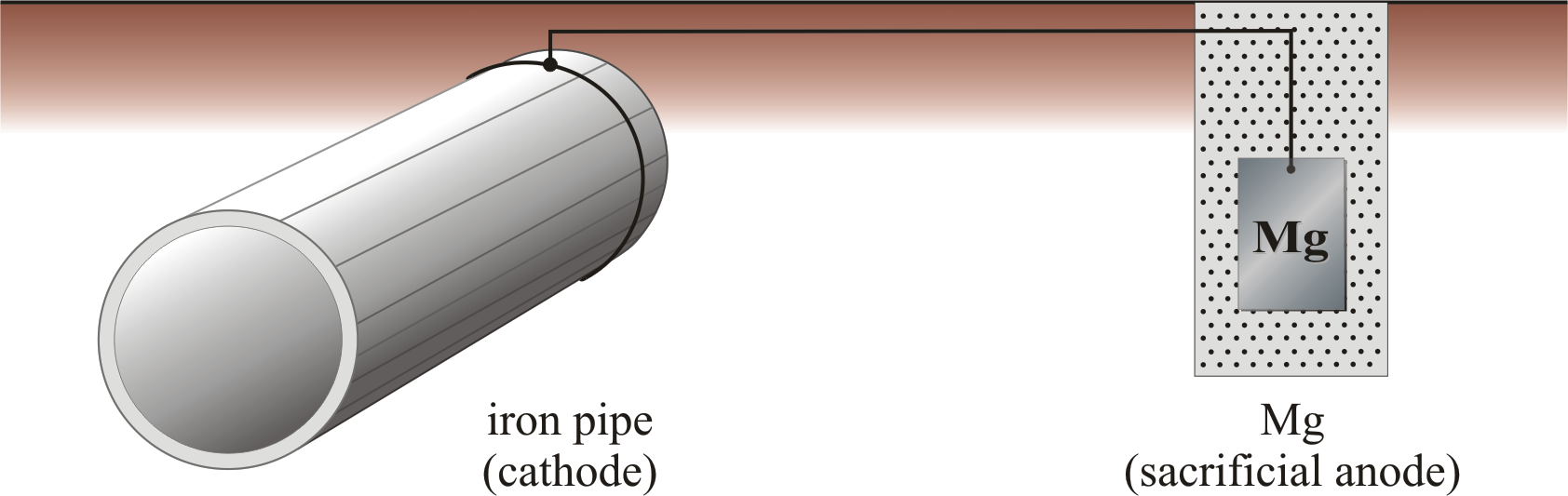
Cathodic protection is a process in which a structural metal, such as iron, is protected from corrosion by connecting it to a metal that has a more negative reduction half-cell potential, which now corrodes instead of iron. There are two major variations of the cathodic method of corrosion protection. The first is called the impressed current method, and the other is called the sacrificial anode method.
overpotential → prenapon
Overpotential (η) is a potential that must be applied in an electrolytic cell in addition to the theoretical potential required to liberate a given substance at an electrode. The value depends on the electrode material and on the current density.
paper → papir
Paper is the thin sheet of material made of cellulose pulp, derived mainly from wood, but also from rags and certain grasses, and processed into flexible leaves or rolls. It is manufactured by bleaching raw material using the bleaching-powder, mixing it with inorganic fillers, colours and glues, and drying. Used primarily for writing, printing, drawing, wrapping, and covering walls.
parchment paper → pergamentni papir
Parchment paper is impermeable paper obtained by dipping cellulosic paper in the sulphuric acid.
Citing this page:
Generalic, Eni. "Electrical cell." Croatian-English Chemistry Dictionary & Glossary. 29 June 2022. KTF-Split. {Date of access}. <https://glossary.periodni.com>.


 English
