
CHEMISTRY GLOSSARY
chlorinity → klorinitet
Originally chlorinity (symbol Cl) was defined as the weight of chlorine in grams per kilogram of seawater after the bromides and iodides had been replaced by chlorides. To make the definition independent of atomic weights, chlorinity is now defined as 0.3285233 times the weight of silver equivalent to all the halides.
The Mohr-Knudsen titration method served oceanographers for more than 60 years to determine salinity from chlorinity. This modification of the Mohr method uses special volumetric glassware calibrated directly in chlorinity units. The Mohr method uses potassium chromate (K2CrO4) as an indicator in the titration of chloride ions chloride (plus a small amount of bromide and iodide) with a silver nitrate (AgNO3) standard solution.
The other halides present are similarly precipitated.
A problem in the Mohr titration was that silver nitrate is not well suited for a primary standard. The Danish physicist Martin Knudsen (1871-1949) suggested that a standard seawater (Eau de mer Normale or Copenhagen Normal Water) be created and distributed to oceanographic laboratories throughout the world. This water was then used to standardize the silver nitrate solutions. In this way all chlorinity determinations were referred to one and the same standard which gave great internal consistency.
The relationship between chlorinity Cl and salinity S as set forth in Knudsen's tables is
In 1962, however, a better expression for the relationship between total dissolved salts and chlorinity was found to be
coenzyme q → koenzim q
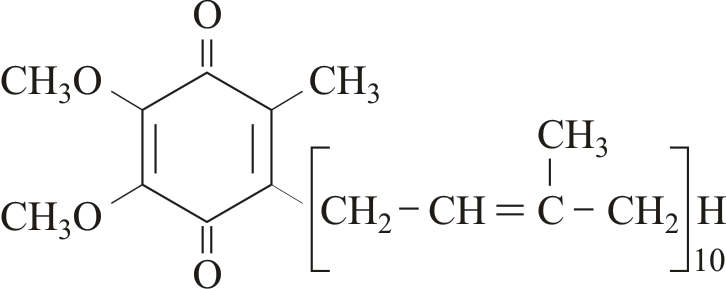
Coenzyme Q (CoQ) or ubiquinone is any of a group of related quinone-derived compounds that serve as electron carriers in the electron transport chain reactions of cellular respiration. There are some differences in the length of the isoprene unit (in bracket on left) side chain in various species. All the natural forms of CoQ are insoluble in water, but soluble in membrane lipids.
natural resins → prirodne smole
Natural resins are organic compounds which are secreted by some plants and insects. They are used as adhesives, and are very often unsoluble in water.
neutral oxide → neutralni oksid
Neutral oxides are those oxides which show neither basic nor acidic properties when they react with water. Examples include carbon monoxide (CO) and nitrous oxide (N2O) which are only slightly soluble in water, and nitric oxide (NO) which is appreciably soluble in cold water.
condensation → kondenzacija
1. Condensation is a process of changing from a gaseous to a liquid or solid state, usually done by cooling.
2. Condensation, in colloid systems, is a process where smaller particle join in one colloid size particle
3. Condensation, in chemical terms, is a sort of chemical reaction in which small molecules like water, carbon dioxide, or ammonia single out.
convection → konvekcija
Convection is the process by which heat is transferred from one part of a fluid to another by movement of the fluid itself. There are two methods by which this can be carried out.
Natural convection, in which movement occurs as a result of gravity. Heat transferred through a fluid medium, such as air or water, by currents that result from the rising of less dense, warm fluid and the sinking of heavier, cooler fluid.
Forced convection is where hot fluid is transferred from one region to another by a mechanical means (fans or pumps).
copolymer → kopolimer
Copolymers are also known as heteropolymers. They are made from two (or more) different monomers, which usually undergo a condensation reaction with the elimination of a simple molecule, such as ammonia or water. A typical example is the condensation of 1,6-diaminohexane (hexamethylenediamine) with hexanedioic acid (adipic acid) to form nylon 6,6.
The properties of a polymeric plastic can most easily be modified if it is a copolymer of two or more different monomers, e.g. acrylonitrile-butadiene-styrene copolymer (ABS). Varying the proportions of the component monomers can preselect its properties.
neutralisation → neutralizacija
Neutralisation is the process in which an acid reacts with a base to form a salt and water.
non-Newtonian fluid → nenewtonski fluid
Non-Newtonian fluid is a fluid whose viscosity changes when the gradient in flow speed changes. Colloidal suspensions and polymer solutions like ketchup and starch/water paste are non-Newtonian fluids.
Citing this page:
Generalic, Eni. "Water gas." Croatian-English Chemistry Dictionary & Glossary. 29 June 2022. KTF-Split. {Date of access}. <https://glossary.periodni.com>.


 English