
CHEMISTRY GLOSSARY
reverse osmosis → reverzna osmoza
Reverse osmosis is the method used for obtaining freshwater from saltwater. The process uses a semi-permeable membrane through which pure water and not the salts will pass. The saltwater must be pressurised to approximately 25 bar, which makes it operationally expensive to produce large quantities of fresh water by this method.
salinisation → salinizacija
Salinisation is the increase in salinity of fresh surface and ground water supplies.
sand filtration → pješčana filtracija
Sand filtration is a frequently used and very robust method of removing suspended solids from water. The filtration medium consists of a multiple layer of sand with a variety in size and specific gravity. Sand filters can be supplied in different sizes and materials, both hand operated and fully automatically.
degree → stupanj
1. Degree is a unit of temperature on a specified scale. The temperatures of boiling and freezing water are: in the Fahrenheit system 212 and 32 degrees; in the Celsius system 100 and 0 (zero) degrees.
2. Degree is a unit of angular measure. A circle is divided into 360 degrees, represented by the symbol °. Degrees are each divided into 60 minutes. Each minute has 60 seconds. Symbols for degree, minute, and second for plane angle is placed after the numerical value and a no space between the numerical value and the unit symbol (α = 2°3'4").
3. In algebra, the degree of a polynomial is the highest power of the variable in the polynomial. For example, 4x3 + 3x2 + x + 7 have degree 3.
density → gustoća
In the most common usage, density (ρ) is mass density or mass per unit volume. In Si units it is measured in kg m-3. More commonly, densities are given in kg dm-3.
More generally, it is the amount of some quantity (mass, charge, energy, etc.) divided by a length, area, or volume.
Relative density is the ratio of the density of a substance to the density of some reference substance. For liquids or solids, it is the ratio of the density (usually at 20 °C) to the density of water at 4 °C. This quantity was formerly called specific gravity.
desiccant dryers → sredstva za sušenje
Desiccant dryers (air dryers) use nonconsumable chemicals such as silica gel or active alumina, and can remove almost all the moisture from compressed air by adsorbing moisture on its surface. The method of regeneration, the process of removing adsorbed water from the desiccant, is the primary distinguishing feature among the various types of desiccant dryers. There are three ways to regenerate a desiccant: with air, internal or external heaters, or a heat pump.
strong electrolyte → jaki elektrolit
Strong electrolytes are those electrolytes which in water solutions completely dissociate into their ions. They conduct electric current very well.
desiccator → eksikator
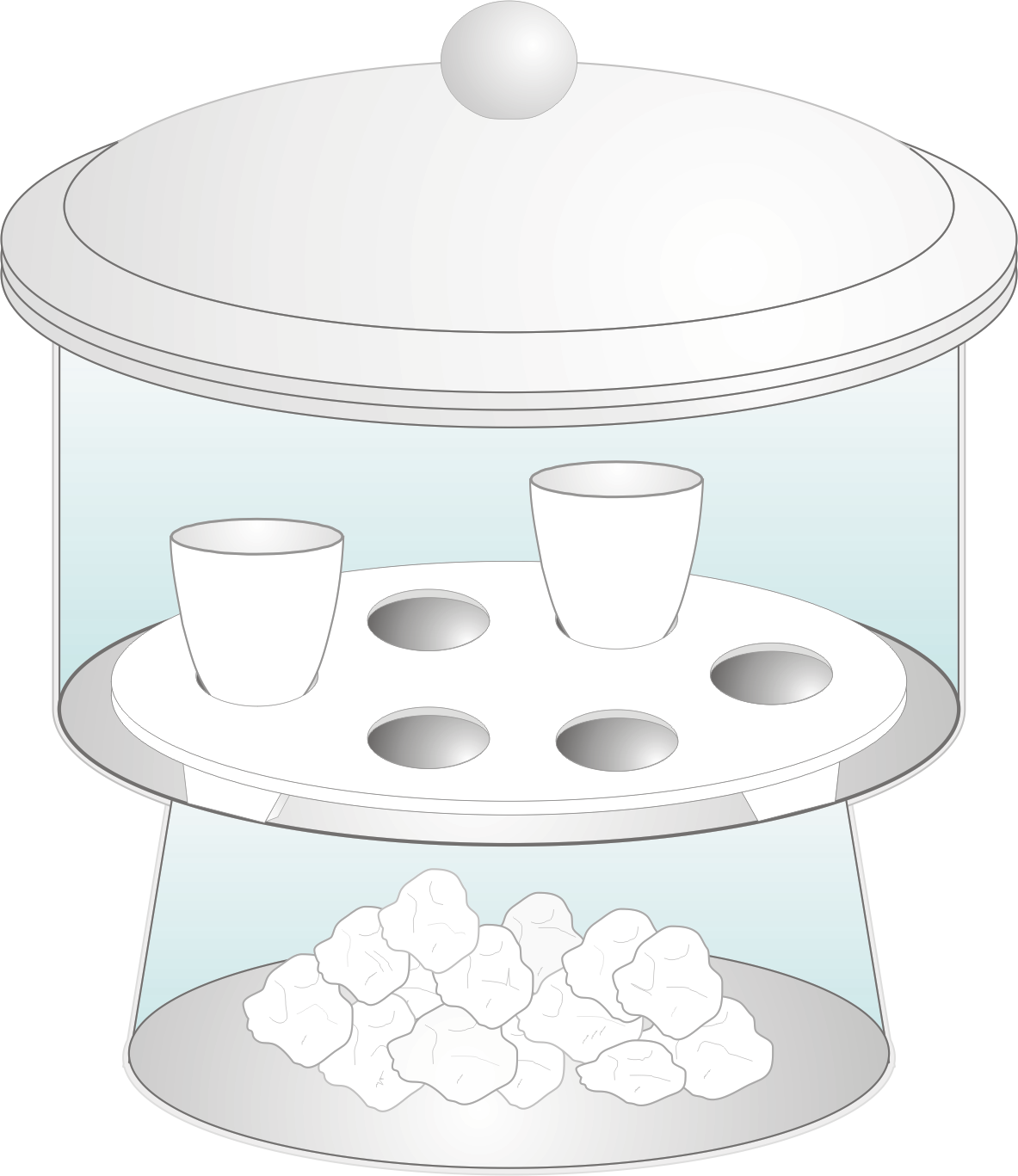
Desiccator is a glass container with dry atmosphere due to the presence of some dehydrating agent. It is used for protecting the samples, reagents or precipitates from humidity. As dehydrating agent usually waterless calcium chloride (CaCl2) is used.
Citing this page:
Generalic, Eni. "Water gas." Croatian-English Chemistry Dictionary & Glossary. 29 June 2022. KTF-Split. {Date of access}. <https://glossary.periodni.com>.


 English