
CHEMISTRY GLOSSARY
nitrogen → dušik
Nitrogen was discovered by Daniel Rutherford (Scotland) in 1772. The origin of the name comes from the Greek words nitron genes meaning nitre and forming and the Latin word nitrum (nitre is a common name for potassium nitrate, KNO3). It is colourless, odourless, generally inert gas. Minimally reactive at room temperature. A component of many organic and inorganic compounds. Makes up about 78 % of earth’s atmosphere. Nitrogen is obtained from liquid air by fractional distillation. Primarily to produce ammonia and other fertilizers. Also used in making nitric acid, which is used in explosives. Also used in welding and enhanced oil recovery.
noble gas → plemeniti plin
Noble gas refers to any element of the group of six elements in group 18 of the periodic table. They are helium (He), neon (Ne), argon (Ar), krypton (Kr), xenon (Xe), and radon (Rn). Unlike most elements, the noble gases are monoatomic. The atoms have stable configurations of electrons. Therefore, under normal conditions they do not form compounds with other elements.
They were generally called inert gases until about 1962 when xenon tetrafluoride, XeF4, was produced in the laboratory. This was the first report of a stable compound of a noble gas with another single element.
nucleotide → nukleotid
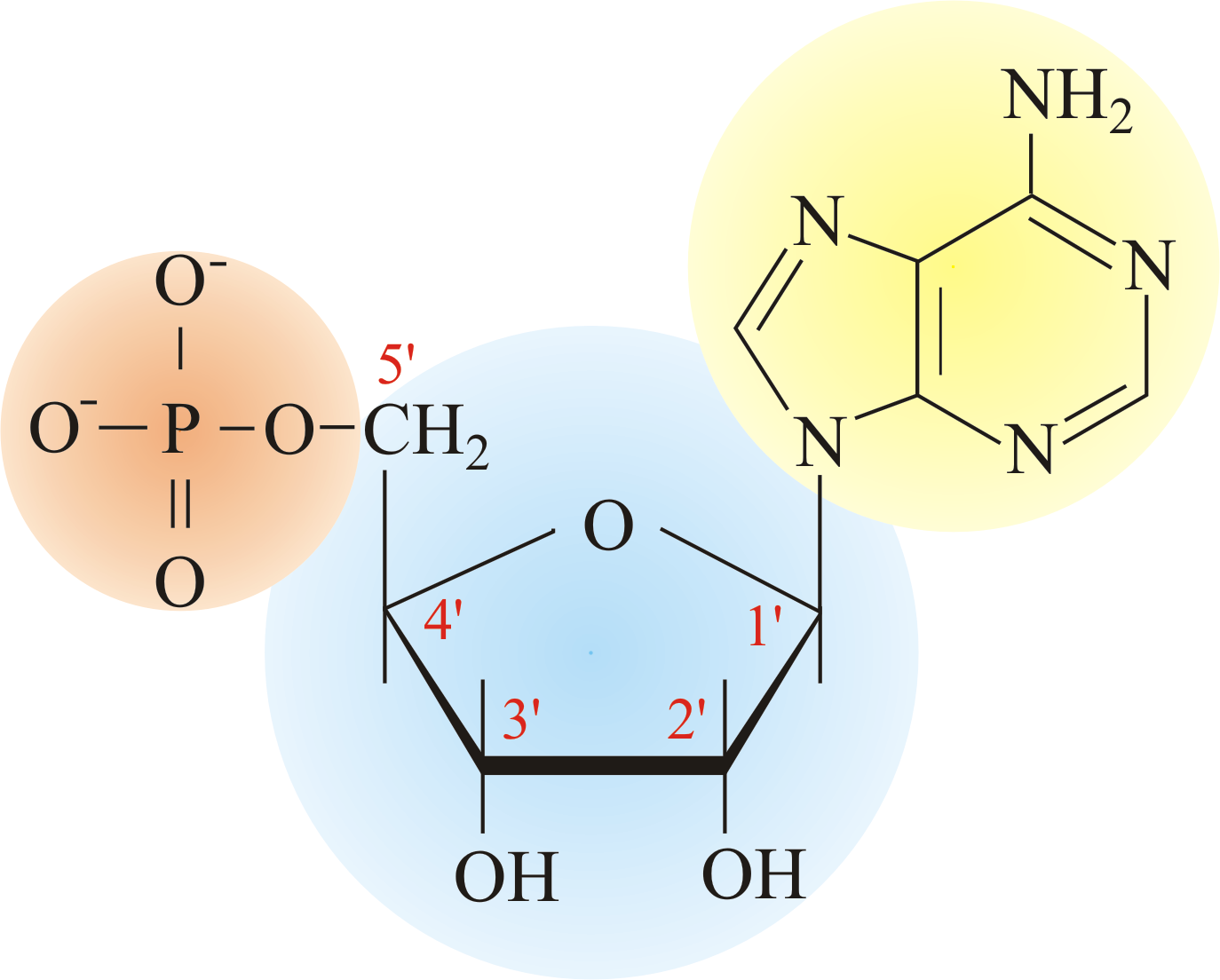
Nucleotides are the components that made up nucleic acids. They have three major components: the first component is a nitrogenous base, which is derivative of one of two parent compounds, pyrimidine or purine; the second is a pentose, or five carbon sugar group; the third is a unit of phosphate. Each group of three nucleotides in a gene is known as a codon. Whenever the phosphate group is not present, a nucleotide becomes a nucleoside.
octahedral molecular geometry → oktaedarska geometrija molekule
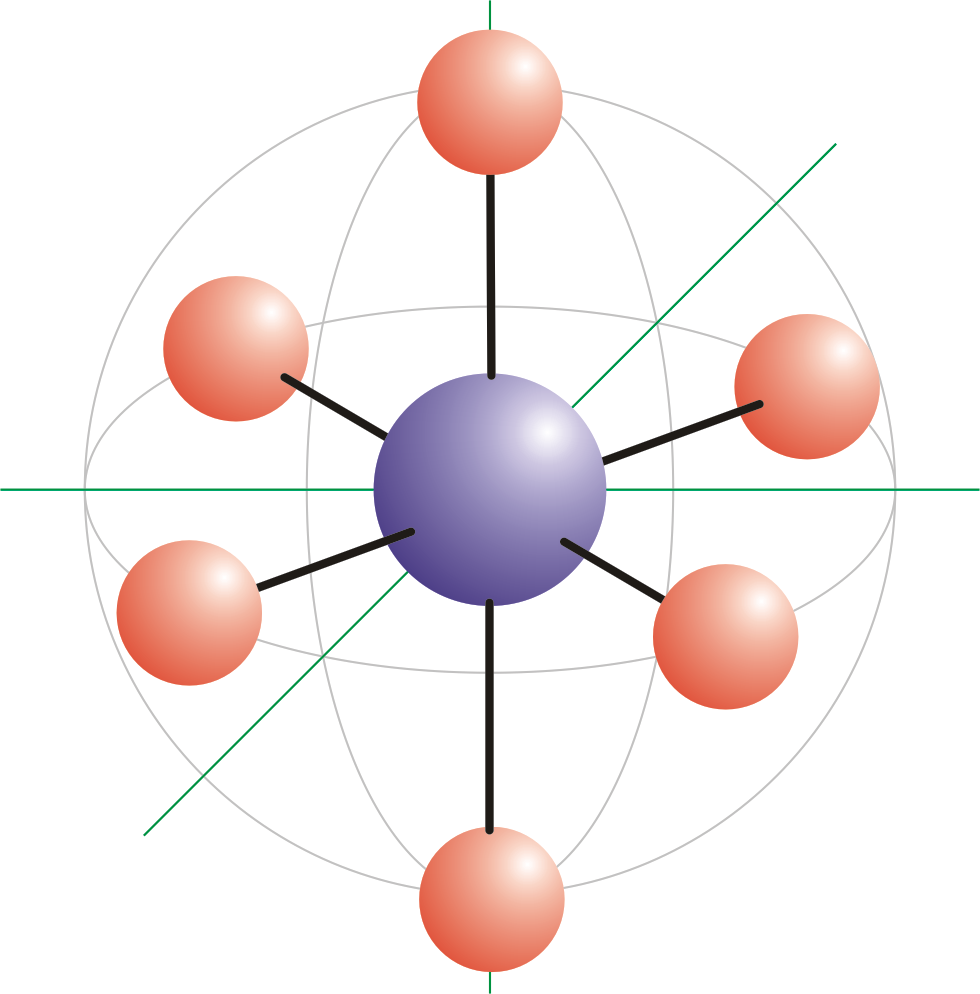
Octahedral molecular geometry (square bipyramidal shape) describes the shape of compounds where six atoms or ligands are symmetrically arranged around a central atom. The sulfur hexafluoride (SF6), with six bonding pairs, is predicted and found to be a regular octahedron. Four of the attachments are positioned in a square plane with 90° bond angles. The remaining two attachments are positioned perpendicular (90°) to the square plane at opposite ends of the central atom. Molecules with an octahedral electron pair geometries have sp3d2 (or d2sp3) hybridization at the central atom.
structural isomer → strukturni izomer
Structural isomers are compounds that have the same formula, but different constituents. Dimethyl ether (CH3OCH3) and ethanol (CH3CH2OH), for example, are constitutional isomers with general formula C3H6O.
superconductivity → supravodljivost
Superconductivity is the phenomenon in which certain metals, alloys, and compounds below a certain temperature, the transition point (Tc), lose electrical resistance and magnetic permeability, i.e. have infinite electrical conductivity (Meissner effect and Josephson effect).
organic → organski
1. Organic refers to any chemical compound based on carbon (C) with the exception of some of the simple compounds of carbon, such as carbon dioxide, which are frequently classified as inorganic compounds. Additional elements that are commonly found in organic compounds are hydrogen (H), nitrogen (N), oxygen (O), phosphorus (P) and sulfur (S).
2. Organic or organically-grown foods are grown or raised without synthetic fertilizers, pesticides, growth stimulators, or antibiotics and other drugs. Pests are controlled by cultivation techniques and the use of pesticides derived from natural sources and the use of natural fertilizers. In addition, organically grown foods must also be stored without the use of chemicals such as artificial additives and preservatives, and without food irradiation.
osmium → osmij
Osmium was discovered by Smithson Tennant (England) in 1803. The origin of the name comes from the Greek word osme meaning smell. It is hard fine black powder or hard, lustrous, blue-white metal. Unaffected by air, water and acids. Characteristic acrid, chlorine like odour due to tetroxide compound. Osmium tetroxide highly toxic. Osmium is obtained from the same ores as platinum. Used to tip gold pen points, instrument pivots, to make electric light filaments. Used for high temperature alloys and pressure bearings. Very hard and resists corrosion better than any other.
paper chromatography → papirna kromatografija
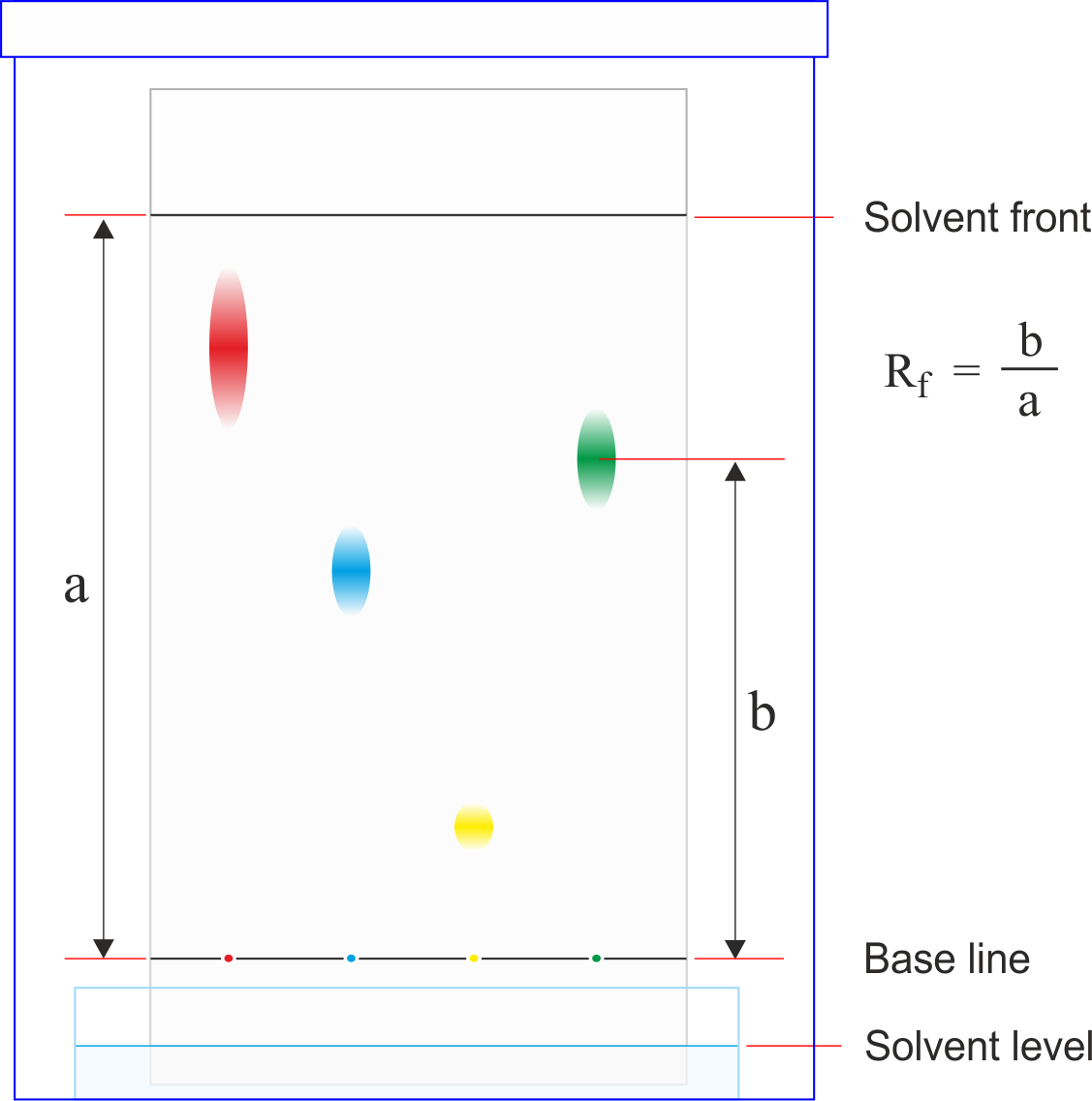
Paper chromatography is one of the types of chromatography procedures which runs on a piece of specialized paper. It is a planar chromatography systems wherein a cellulose filter paper acts as a stationary phase on which separation of compounds occurs. The edge of the paper is immersed in a solvent, and the solvent moves up the paper by capillary action.
unsaturated hydrocarbon → nezasićeni ugljikovodik
Unsaturated hydrocarbons are organic compounds containing double (alkenes) or triple (alkynes) bonds in their molecules.
Citing this page:
Generalic, Eni. "Oxo compound." Croatian-English Chemistry Dictionary & Glossary. 29 June 2022. KTF-Split. {Date of access}. <https://glossary.periodni.com>.


 English

