
CHEMISTRY GLOSSARY
gas → plin
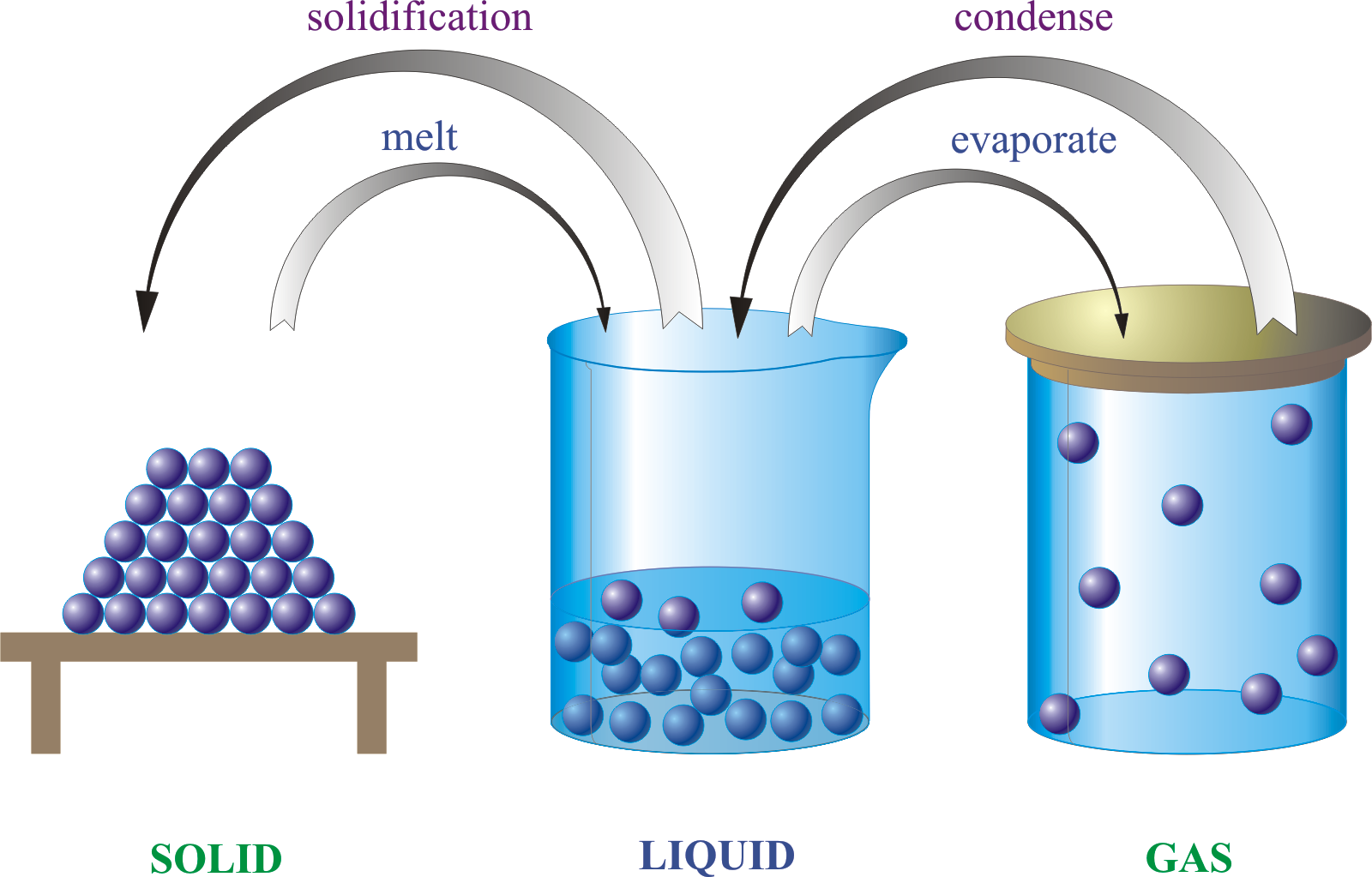
Gas is a state of matter, in which the mollecules move freely and consequently the entire mass tends to expand indefinitely, occupying the total volume of any vessel into which it is introduced. Gases follow, within considerable degree of fidelity, certain laws relating their conditions of pressure, volume and temperature. Gases mix freely with each other, and they can be liquefied through compression or temperature reduction.
Pauli exclusion principle → Paulijev princip zabrane
Pauli exclusion principle is the statement that two electrons in an atom cannot have identical all four quantum numbers. It was first formulated in 1925 by the Austrian-born Swiss physicst Wolfgang Ernst Pauli (1900-1958).
peptisation → peptizacija
Peptisation is a process in which coagulated colloid returns into a dispersed state.
reaction layer → reakcijski sloj
Reaction layer (in electrochemistry) is that layer of solution adjacent to an electrode within which a stationary distribution of electroactive species is established as the result of homogeneous reaction.
equilibrium constant → konstanta ravnoteže
The equilibrium constant (K) was originally introduced in 1863 by Norwegian chemists C.M. Guldberg and P. Waage using the law of mass action. For a reversible chemical reaction represented by the equation
chemical equilibrium occurs when the rate of the forward reaction equals the rate of the back reaction, so that the concentrations of products and reactants reach steady-state values.
The equilibrium constant is the ratio of chemical activities of the species A, B, C, and D at equilibrium.
To a certain approximation, the activities can be replaced by concentrations.
For gas reactions, partial pressures are used rather than concentrations
The units of Kp and Kc depend on the numbers of molecules appearing in the stoichiometric equation (a, b, c, and d).
The value equilibrium constant depends on the temperature. If the forward reaction is exothermic, the equilibrium constant decreases as the temperature rises. The equilibrium constant shows the position of equilibrium. A low value of K indicates that [C] and [D] are small compared to [A] and [B]; i.e. that the back reaction predominates.
The equilibrium constant is related to ΔrG°, the standard Gibbs free energy change in the reaction, by
regeneration → regeneracija
Regeneration is the process of restoring an ion exchange medium to a usable state after exhaustion. The cation exchanger is normally regenerated with hydrochloric acid and the anion exchanger with sodium hydroxide.
solution → otopina
Solutions are homogeneous mixtures of clean substances. Solutions contain two or more substances mixed in a state of molecular dispersion. Component which is found in solution in greater amount than other components is called a solvent and other components are called dissolved substances. Solution can be unsaturated, saturated and oversaturated.
gas liquefying → ukapljivanje plinova
In order to achieve transition of a gas into liquid state it is necessary to lower its temperature, or decrease its volume, or increase its pressure. Above the critical temperature it is impossible to liquefy a gas. When liquefying a gas by Linde’s procedure, dampening or Joule-Thomson’s effect is used. First, the compressed air from the compressor is cooled with cooling water, the cooled air expands at a lower pressure in the dampening valve at which it cooled. The cooled air now returns to the compressor, cooling down the expanding air. By repeating this process the air is cooled enough to transit to the liquid state.
Citing this page:
Generalic, Eni. "Nascent state." Croatian-English Chemistry Dictionary & Glossary. 29 June 2022. KTF-Split. {Date of access}. <https://glossary.periodni.com>.


 English