
CHEMISTRY GLOSSARY
kelvin → kelvin
Kelvin (K) is the SI base unit of thermodynamic temperature.
The kelvin, unit of thermodynamic temperature, is the fraction 1/273.16 of the thermodynamic temperature of the triple point of water. The unit was named after the British scientist Sir. W. Thompson, Lord Kelvin (1824-1907).kilogram → kilogram
Kilogram (kg) is the SI base unit of mass; it is equal to the mass of the international prototype of the kilogram.
The prototype of the standard is a cylinder of platinum-iridium alloy (90:10), 39 mm in diameter and 39 mm high. Prototype of the kilogram kept by the Bureau International des Poids et Mesures (International Bureau of Weights and Measures) at Sèevres, near Paris.
Knudsen’s pipette → Knudsenova pipeta
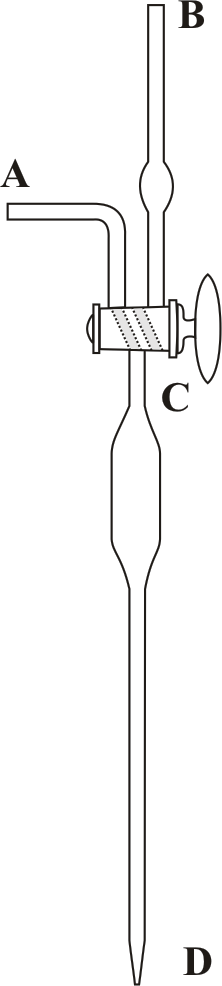
Kudsen's automatic pipette, developed by the Danish physicist Martin Knudsen (1871-1949), allows quick and accurate transfer of a constant volume of liquid (sea water), usually around 15 mL. On the top of pipette is a double sided C vent that can establish flow between the body of the pipette and one of the branches (A or B), or isolate the body of the pipette from both of the branches. Sucking through the B branch the pipette is filled with liquid, it is closed with a twist of the C valve and the liquid is released by rotating the valve towards the A branch (so atmospheric air can enter the pipette). Emptying the pipette takes around 30 seconds. Before it's first use, the pipette must be calibrated with distilled water.
lanthanides → lantanoidi
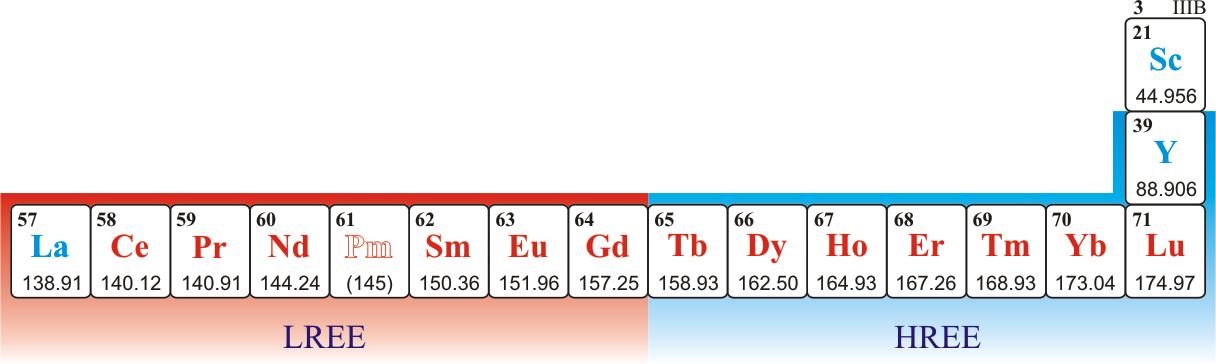
Lanthanides (lanthanons, lanthanoids or rare-earth elements) are a series of fourteen elements in the periodic table, generally considered to range in proton number from cerium to lutetium inclusive. It was convenient to divide these elements into the cerium group or light earth: cerium (Ce), praseodymium (Pr), neodymium (Nd), promethium (Pm), samarium (Sm), europium (Eu); and the yttrium group or heavy earths: gadolinium (Gd), terbium (Tb), dysprosium (Dy), holmium (Ho), erbium (Er), thulium (Tm), ytterbium (Yb) i lutetium (Lu). The position of lanthanum is somewhat equivocal and, although not itself a lanthanide, it is often included with them for comparative purpose. The lanthanides are sometimes simply called the rare earths. Apart from unstable Pm, the lanthanides are actually not rare. Cerium is the 26. most abundant of all elements, 5 times as abundant as Pb. All are silvery very reactive metals.
transumutation → transmutacija
Transmutation is the conversion of one element into another by a process taking place in the nucleus.
lanthanum → lantan
Lanthanum was discovered by Carl Gustaf Mosander (Sweden) in 1839. The origin of the name comes from the Greek word lanthanein meaning to lie hidden. It is soft, silvery-white, malleable, ductile metal. Readily tarnishes in air. Reaction with water releases hydrogen gas. Metal ignites and burns readily. Reacts with oxidants. Lanthanum is found with rare earths in monazite and bastnasite. Monazite sand typical contains 25 % lanthanum. It is used in the electrodes of high-intensity, carbon-arc lights. Because it gives glass refractive properties, it is used in expensive camera lenses.
lead → olovo
Lead has been known since ancient times. The origin of the name comes from the Latin word plumbum meaning liquid silver. It is very soft, highly malleable and ductile, blue-white shiny metal. Tarnishes in moist air; stable in oxygen and water. Dissolves in nitric acid. Compounds toxic by inhalation or ingestion. Danger of cumulative effects. Lead is found most often in ores called galena or lead sulfide (PbS). Used in solder, shielding against radiation and in batteries.
Citing this page:
Generalic, Eni. "/tab." Croatian-English Chemistry Dictionary & Glossary. 29 June 2022. KTF-Split. {Date of access}. <https://glossary.periodni.com>.


 English
