
CHEMISTRY GLOSSARY
micelle → micele
Micelle is an electrically charged colloidal particle, usually organic in nature, composed of aggregates of large molecules, e.g., in soaps and surfactants. For aqueous solutions, the hydrophilic end of the molecule is on the surface of the micelle, while the hydrophobic end (often a hydrocarbon chain) points toward the centre.
microchemistry → mikrokemija
Microchemistry is a branch of chemistry that concerns isolating, identifying and an analysis of very small quantities of sample (few mg). It uses delicate reactions, special equipment and microscopes.
glycoside → glikozid
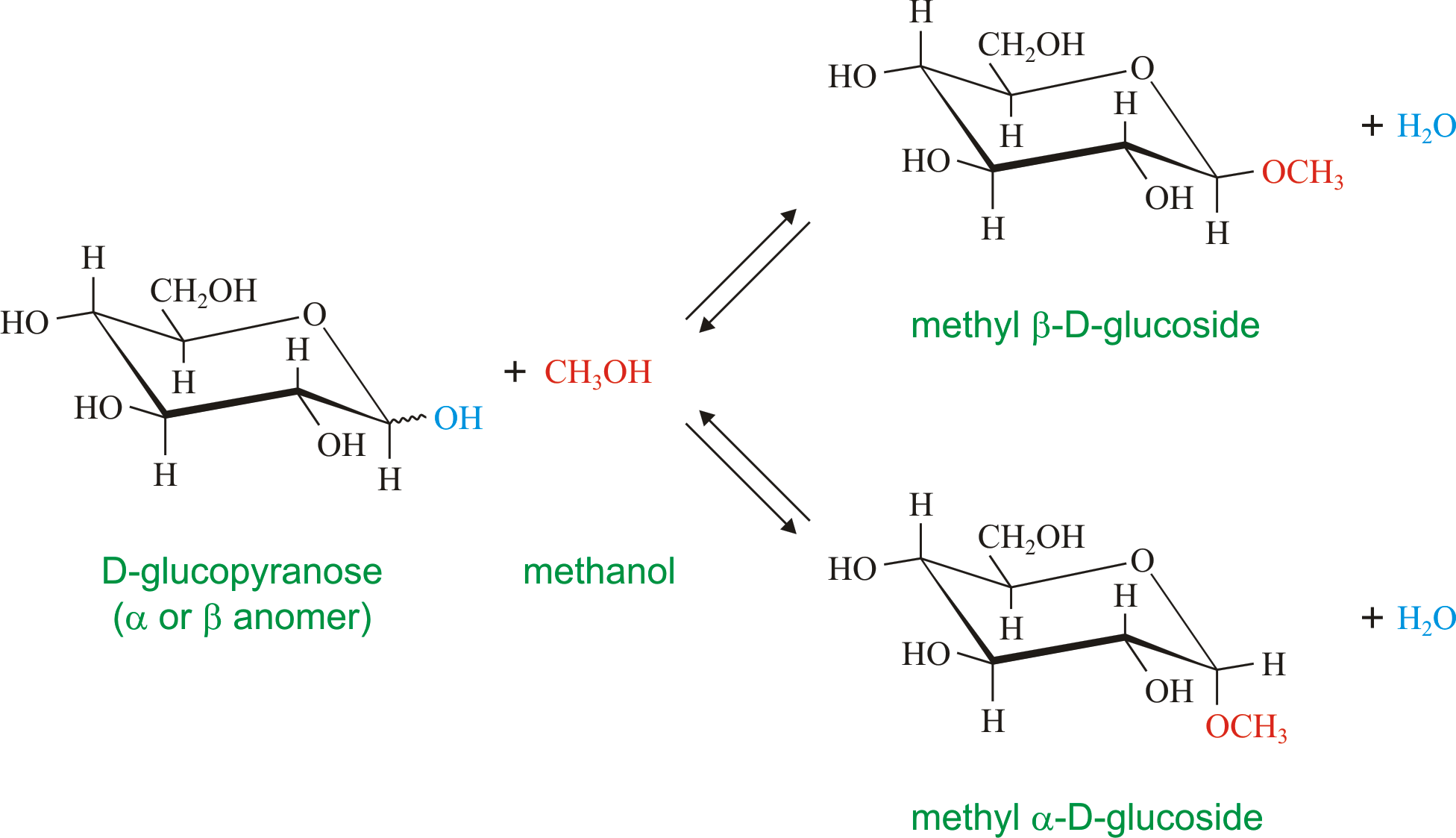
Glycoside is one of a group of organic compounds in which a sugar group is bonded through its anomeric carbon to another group via a glycosidic bond. The sugar group is known as the glycon and the non-sugar group as the aglycon. According to the IUPAC definition, all disaccharides and polysaccharides are glycosides where the aglycone is another sugar.
In the free hemiacetal form, sugars will spontaneously equilibrate between the α and β anomers. However, once the glycosidic bond is formed, the anomeric configuration of the ring is locked as either α or β. Therefore, the alpha and beta glycosides are chemically distinct. They will have different chemical, physical, and biological properties. Many glycosides occur abundantly in plants, especially as flower and fruit pigments.
The term glycoside was later extended to cover not only compounds in which the anomeric hydroxy group is replaced by a group -OR, but also those in which the replacing group is -SR (thioglycosides), -SeR (selenoglycosides), -NR1R2 (N-glycosides), or even -CR1R2R3 (C-glycosides). Thioglycoside and selenoglycoside are legitimate generic terms; however the use of N-glycoside, although widespread in biochemical literature, is improper and not recommended here (glycosylamine is a perfectly acceptable term). C-Glycoside is even less acceptable. All other glycosides are hydrolysable; the C-C bond of C-glycosides is usually not. The use and propagation of names based on C-glycoside terminology is therefore strongly discouraged.
ketal → ketal
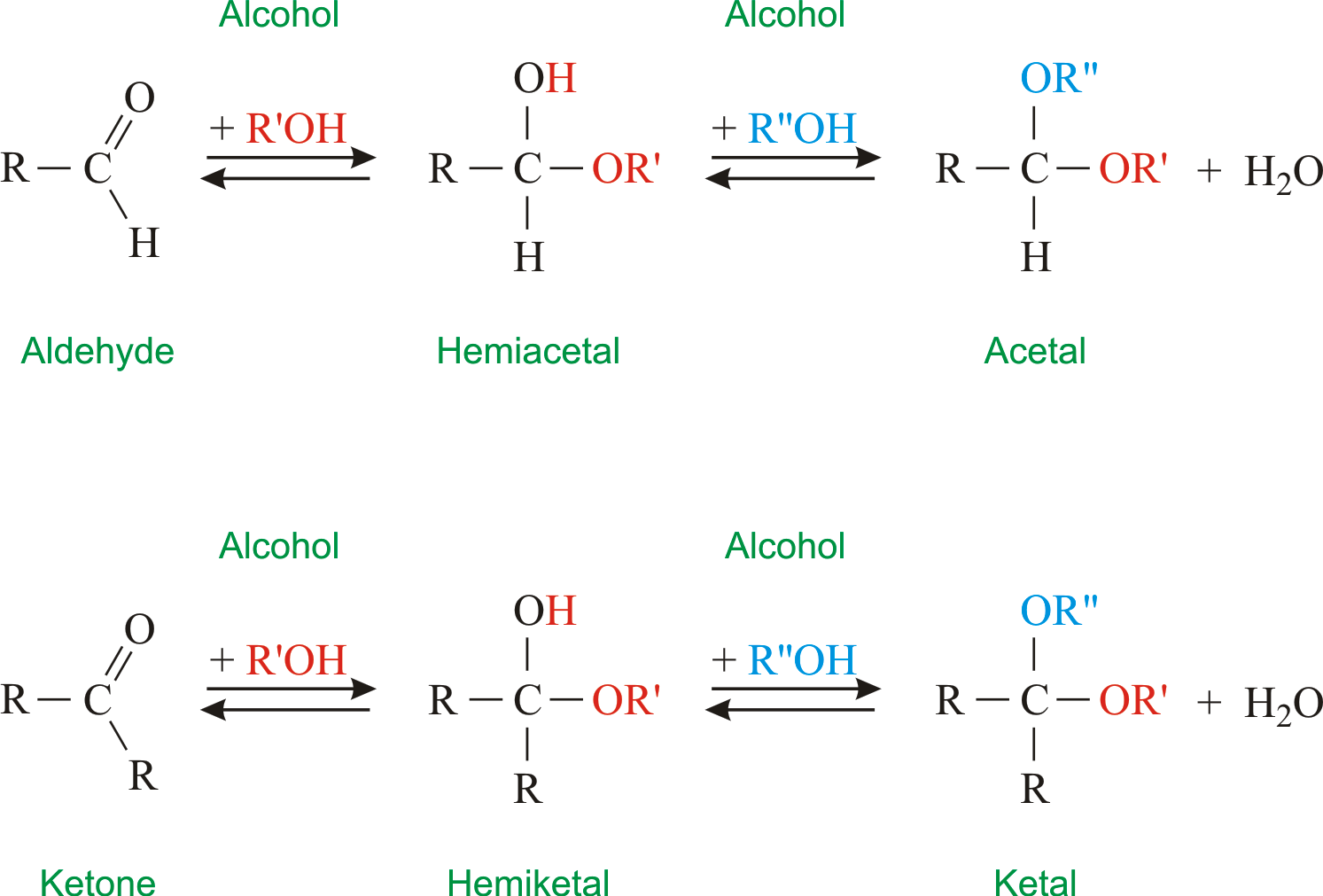
Ketals are organic compounds formed by addition of an alcohol to a ketone. If one molecule of ketone (RR’CO) reacts with one molecule of alcohol (R"OH) then a hemiketal is formed. The rings of ketose sugars are hemiketals. Further reaction produces a full ketal (RR’C(OR")2). This term, once abandoned, has been reinstated as a subclass of acetals.
mineralization → mineralizacija
Mineralization is a process in which organic compounds (e.g. dead plant or animal material) are converted to inorganic compounds (e.g. nitrate, carbon dioxide).
mutagenic substance → mutagena tvar
Mutagenic substances are substances that cause mutation, a change in inheritable properties of an organism.
natural resins → prirodne smole
Natural resins are organic compounds which are secreted by some plants and insects. They are used as adhesives, and are very often unsoluble in water.
nitro colour → nitrobojilo
Nitro colours are artificial organic colours that contain nitro-group. They are used for colouring skin, wool and silk.
Gratzel solar cell → Gratzelova sunčeva ćelija
Grätzel solar cell is photoelectrochemical cell, developed by Michael Grätzel and collaborators, simulates some characteristics of the natural solar cell, which enables photosynthesis take place. In natural solar cell the chlorophyll molecules absorb light (most strongly in the red and blue parts of the spectrum, leaving the green light to be reflected). The absorbed energy is sufficient to knock an electron from the excited chlorophyll. In the further transport of electron, other molecules are involved, which take the electron away from chlorophyll. In Grätzel cell, the tasks of charge-carrier generation and transport are also assigned to different species.
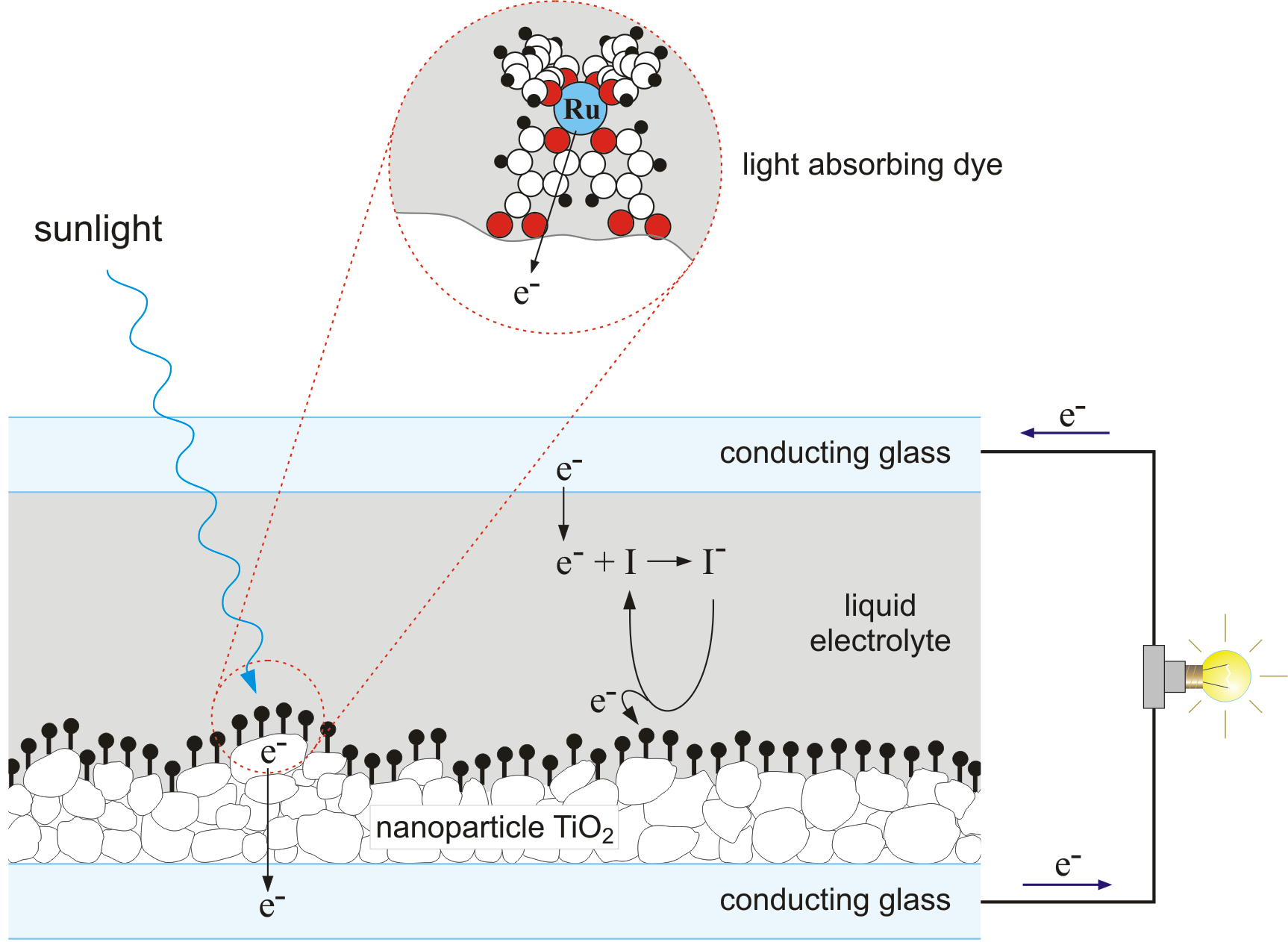
His device consists of an array of nanometre-sized crystallites of the semiconductor titanium dioxide, welded together and coated with light-sensitive molecules that can transfer electrons to the semiconductor particles when they absorb photons. So, light-sensitive molecules play a role equivalent to chlorophyll in photosynthesis. In Grätzel cell, the light-sensitive molecule is a ruthenium ion bound to organic bipyridine molecules, which absorb light strongly in the visible range; titanium dioxide nanocrystals carry the received photoexcited electrons away from electron donors. On the other hand, a donor molecule must get back an electron, so that it can absorb another photon. So, this assembly is immersed in a liquid electrolyte containing molecular species (dissolved iodine molecules) that can pick up an electron from an electrode immersed in the solution and ferry it to the donor molecule. These cells can convert sunlight with efficiency of 10 % in direct sunlight and they are even more efficient in diffuse daylight.
Citing this page:
Generalic, Eni. "Organic chemistry." Croatian-English Chemistry Dictionary & Glossary. 29 June 2022. KTF-Split. {Date of access}. <https://glossary.periodni.com>.


 English

