
CHEMISTRY GLOSSARY
alanine → alanin
Alanine is hydrophobic amino acids with aliphatic side chain. It is the second simplest amino acid, but used the most in proteins. The nonpolar hydrophobic amino acids tend to cluster together within proteins, stabilizing protein structure by means of hydrophobic interactions. Alanine is a nonessential amino acid, meaning it can be manufactured by the human body, and does not need to be obtained directly through the diet.
- Abbreviations: Ala, A
- IUPAC name: 2-aminopropanoic acid
- Molecular formula: C3H7NO2
- Molecular weight: 89.09 g/mol

amphoteric substances → amfoterna tvar
Amphoteric substances can behave as acids or as bases depending upon their surroundings. So aluminium hydroxide in reaction with acids will behave as a base
and in reaction with bases it will act as an acid
aqua regia → zlatotopka
Aqua regia is a mixture of one volume part of nitric acid (HNO3) and three volume parts of hydrochloric acid (HCl). Dissolving of gold in aqua regia is described by the following equation:
arginine → arginin
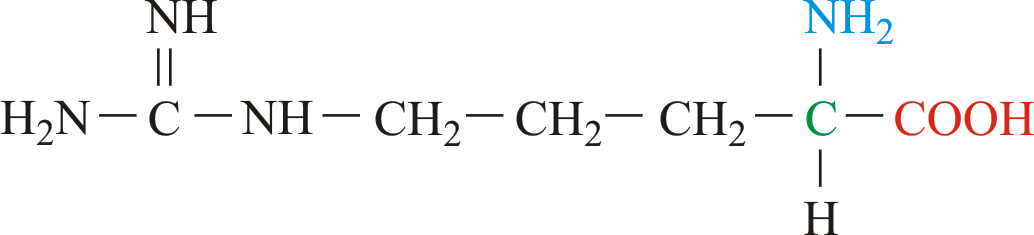
Arginine is an electrically charged amino acids with basic side chains. It is one of the least frequent amino acids. As a group the charged amino acids are important for making proteins soluble. These residues are generally located on the surface of the protein. Arginine is well designed to bind the phosphate anion, and is often found in the active centers of proteins that bind phosphorylated substrates. As a cation, arginine, as well as lysine, plays a role in maintaining the overall charge balance of a protein. Although arginine is considered an essential amino acid (it must be obtained through the diet), this is true only during the juvenile period in humans.
- Abbreviations: Arg, R
- IUPAC name: 2-amino-5-(diaminomethylideneamino)pentanoic acid
- Molecular formula: C6H14N4O2
- Molecular weight: 174.20 g/mol
arsenic → arsen
Arsenic was discovered by Albertus Magnus (Germany) in 1250. The origin of the name comes from the Greek word arsenikon meaning yellow orpiment. It is steel-grey, brittle semi-metal. Resists water, acids and alkalis. Tarnishes in air, burns in oxygen. Highly toxic by inhalation or ingestion. Arsenic is found in mispickel (arsenopyrite). Many of its compounds are deadly poison and used as weed killer and rat poison. Used in semiconductors. Some compounds, called arsenides, are used in the manufacture of paints, wallpapers and ceramics.
biochemistry → biokemija
Biochemistry is the study of the chemistry of living organisms, especially the structure and function of their chemical components (principally proteins, carbohydrates, lipids and nucleic acids).
blanching → blanširanje
1. Blanching is a heat treatment of foodstuffs to partially or completely inactivate the naturally occurring enzymes prior to freezing.
2. Blanching is a washing process for coins cleaning. The black surface layer of cupric oxide is removing by dipping the coins in hot dilute sulphuric acid (w(H2SO4) = 10 %).
asparagine → asparagin
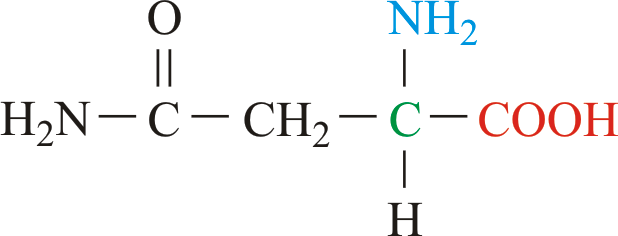
Asparagine is neutral amino acids with polar side chains. The polar amino acids are an important class of amino acids since they provide many of the functional groups found in proteins. Asparagine is a common site for attachment of carbohydrates in glycoproteins. In general this is not very reactive residues. Asparagine is amide derivative of aspartic acid. Asparagine is not essential for humans, which means that it can be synthesized from central metabolic pathway intermediates and is not required in the diet.
- Abbreviations: Asn, N
- IUPAC name: 2,4-diamino-4-oxobutanoic acid
- Molecular formula: C4H8N2O3
- Molecular weight: 132.12 g/mol
autocatalysis → autokataliza
Autocatalysis is a reaction in which its product can act as a catalyst. Oxalate oxidation with permanganate in an acid solution is a slow reaction
Mn2+-ions catalyse this reaction. When enough Mn2+-ions are created, the reaction occurs instantly.
Citing this page:
Generalic, Eni. "Acid radical." Croatian-English Chemistry Dictionary & Glossary. 29 June 2022. KTF-Split. {Date of access}. <https://glossary.periodni.com>.


 English

